Key Takeaways
- Exosome stem cell therapy uses cell-free vesicles instead of whole cells to support repair and calm inflammation.
- Exosomes carry proteins, lipids, and signaling molecules that support cell communication between damaged and healthy tissue.
- Research shows exosomes can help reduce inflammation and modulate immune response in chronic and autoimmune conditions.
- Compared to traditional stem cell therapy, exosome treatment avoids whole-cell risks while still supporting tissue repair and regeneration.
- Applications range from joint and autoimmune support to skin renewal and hair follicle stimulation.
Estimated read: 9 min
Chronic inflammation wears down tissue faster than the body can repair it. Exosome stem cell therapy offers a cell-free way to support that repair process. It avoids the risks associated with whole-cell treatments, making it an increasingly popular option for long-standing conditions.
What Is Exosome Stem Cell Therapy?
Exosome stem cell therapy uses tiny vesicles released by stem cells, rather than the stem cells themselves. This makes it a cell free approach within regenerative medicine. The vesicles carry much of the same therapeutic cargo as the parent cells that released them.
Most clinics use MSC derived exosomes. These come from mesenchymal stem cells (MSCs), often bone marrow derived or sourced from umbilical cord tissue. Each cell type produces a slightly different exosome profile because the parent cell determines which cargo goes inside.
Inside each exosome, the cell packs proteins, lipids, and genetic material such as microRNA. This cargo confers the therapeutic effect of exosomes upon their arrival at damaged tissue. The vesicles cause no immune rejection, since they carry no living cells that the body could attack.
Quality control matters throughout this process. For instance, manufacturers test exosome batches for particle size, concentration, and sterility before release. This testing helps confirm the vesicles meet the standard needed for clinical use.
The size of these vesicles also plays an important role. Specifically, exosomes measure only 30 to 150 nanometers across, far smaller than a whole stem cell. This small size helps them travel through tissue more easily and reach areas a full cell might struggle to access.
Cyrona Cell uses Wharton’s jelly-derived exosomes as part of its broader exosome treatment protocols. For more on the science behind this approach, see exosome and secretome-based stem cell therapy at Cyrona Cell.

How Exosomes Support Cell Communication and Repair
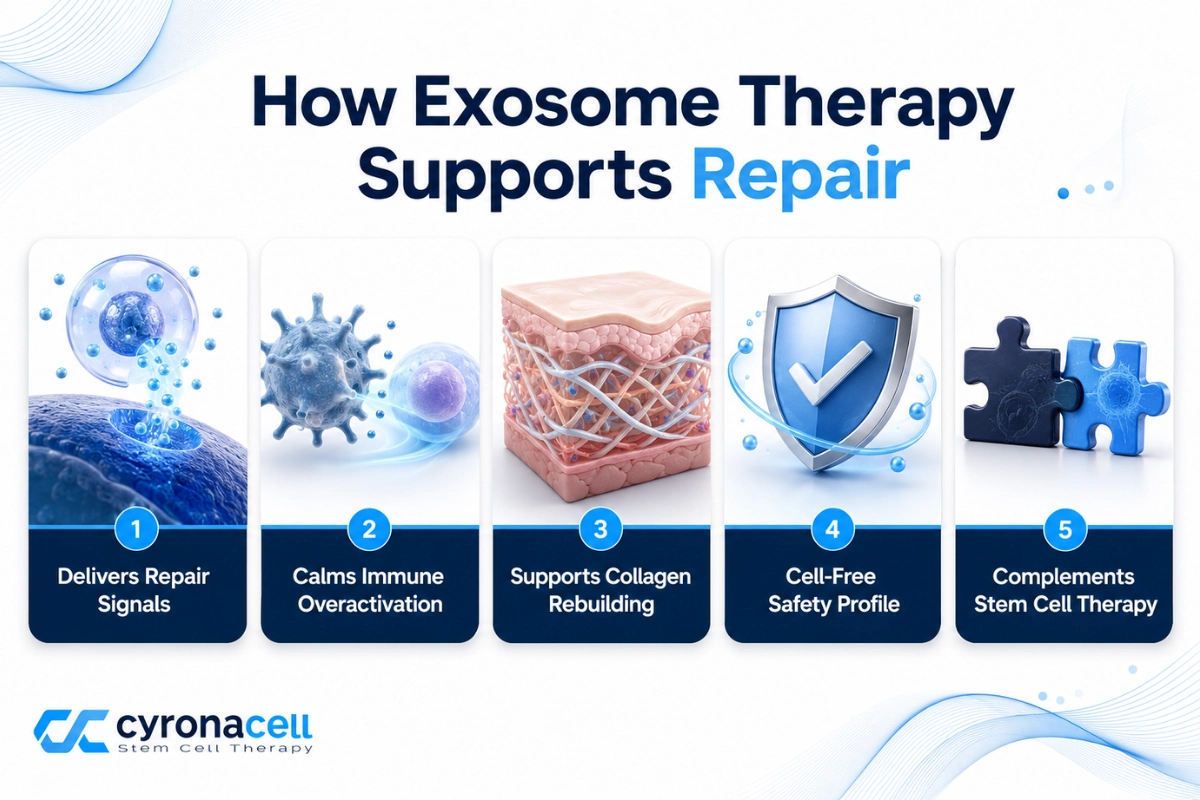
Exosomes work through cell communication. They travel from the donor stem cell to nearby tissue and deliver their cargo directly into the target cell. This process does not require the donor cell to survive or integrate into the new tissue.
Once delivered, the cargo signals damaged tissue to begin repair. Researchers have documented this effect across models of tissue damage, including joint, skin, and organ injury. The signals support tissue repair and regeneration without replacing the tissue itself.
This communication runs in both directions. Exosomes also pick up signals from injured tissue. In turn, this feedback helps the donor cell calibrate what kind of repair support the site actually needs.
A 2023 review in PMC found that MSC-derived exosomes support wound healing. The review described how exosomes regulate immune response and aid collagen-related tissue remodeling in skin repair. This same pattern appears in other tissue types as well.
The same communication process also explains reducing scarring after tissue injury. Exosomes help regulate collagen production during healing. This affects how visible scar tissue becomes once the wound has closed.

How Exosome Therapy Helps Control Inflammation
Chronic inflammation often persists because immune cells stay activated longer than needed. Exosomes appear to help calm this activity. They signal these cells to stand down once the original danger has passed.
This matters most in autoimmune and long term conditions involving inflammation. In these cases, the immune system attacks healthy tissue by mistake. Exosomes seem to adjust this immune response rather than suppress it entirely.
This kind of adjustment importantly differs from suppression. Broadly suppressing the immune system can leave a patient more vulnerable to infection. Adjusting it instead aims to correct the specific overactive response, without weakening overall immune function across the body.
A 2024 review of exosome-based therapies found consistent evidence of reduced inflammation. This pattern held across several inflammatory disorders, including joint and bowel conditions. Researchers describe exosomes as a promising option for managing inflammation-related disorders through cell-free vesicle therapy.
Patients managing autoimmune joint conditions sometimes explore exosome support. This often happens alongside stem cell therapy for rheumatoid arthritis, since both approaches target similar underlying immune activity. Similarly, bowel conditions involving inflammation and certain skin disorders follow this pattern, where chronic immune activation drives ongoing tissue damage.
What Current Research Shows
Researchers have studied exosome therapy across a wide range of conditions. Joint problems, bowel disorders, and skin injury currently hold the strongest evidence base. These tissues are easier to study directly than internal organs.
Most published research still comes from laboratory and animal models, rather than large human trials. Clinical studies in humans are growing, however, particularly for joint and autoimmune applications where early results look promising. Multiple sclerosis and chronic wound studies have also begun recruiting patients in recent years.
Study design varies considerably across this research. Notably, sample sizes remain small in most human trials to date, and follow-up periods vary widely across studies. These factors make direct comparisons between trials difficult at this stage.
This stage of research matters for patients to understand. Exosome therapy is an active and evolving field, not a fully settled treatment with universal outcomes. Individual results can vary based on the condition, its severity, and the patient’s overall health.
Safety data and clinical outcomes deserve their own focused discussion, given the nuance in the evidence base. For now, patients should treat exosome therapy as a promising option supported by growing evidence, not a guaranteed fix. A medical review remains the best way to judge fit for any individual case.

Where Exosome Stem Cell Therapy Is Used
Clinics currently apply exosome therapy across several chronic and cosmetic applications. Notably, joint and autoimmune support remain the most-studied use cases, given the inflammation-control mechanism described above.
Skin applications also rely on the same biology. Exosomes support collagen production and help with reducing scarring. This makes them popular in cosmetic and wound-recovery settings across Malaysia and abroad.
Hair follicles respond to exosome signaling as well. Early research suggests the same repair cargo that helps skin and joints may also support follicle health over time. Some patients pursue this specifically for thinning or early hair loss.
Recovery support is another growing application. For example, patients recovering from injury or surgery sometimes use exosome therapy to support the body’s natural repair timeline.
This differs from treating one diagnosed condition. The goal here is faster overall recovery, not a single targeted fix.
A full breakdown of these specific applications, including skin, joints, and recovery protocols, deserves its own deeper guide. For now, the full list of supported conditions is available through the Cyrona Cell treatments directory.
Exosome Therapy vs Traditional Stem Cell Therapy
Traditional stem cell therapy introduces living cells into the body. Cell based therapies like this carry some risk of immune reaction. This happens because the cells themselves must survive and function in a new environment.
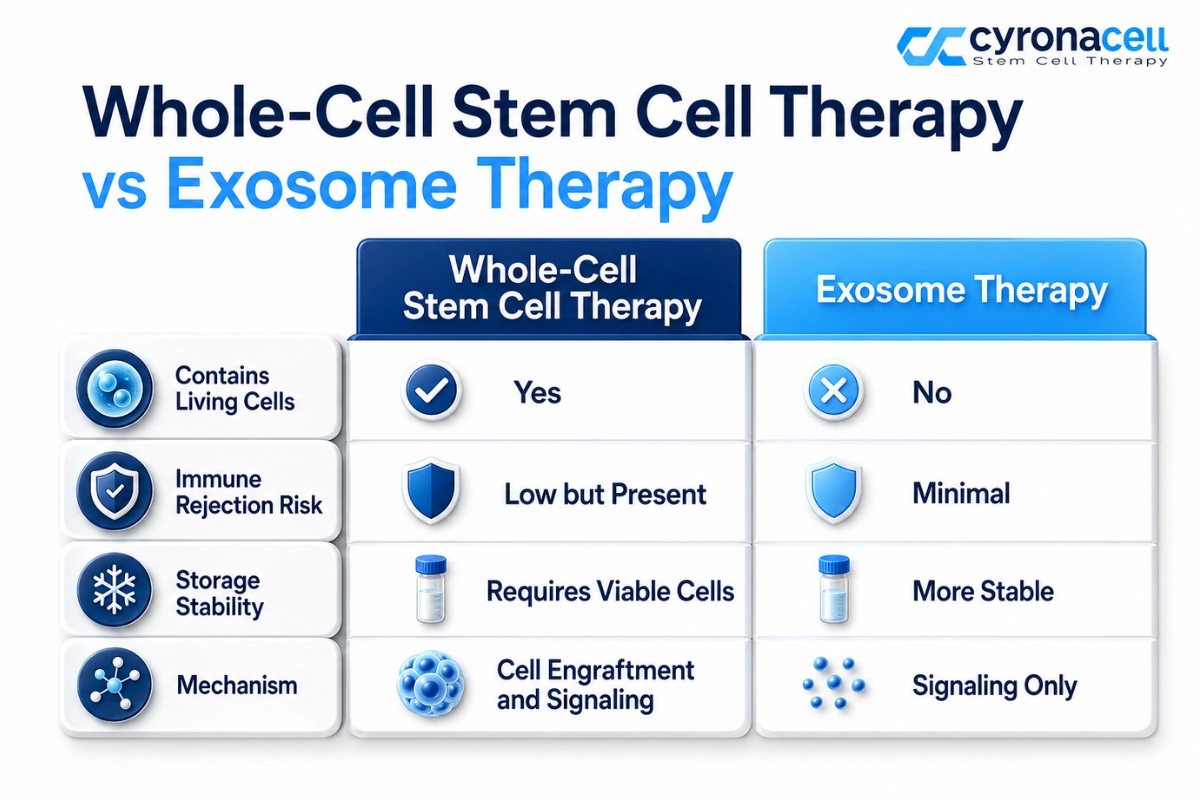
| Factor | Whole-Cell Stem Cell Therapy | Exosome Therapy |
|---|---|---|
| Contains living cells | Yes | No |
| Immune rejection risk | Low, but present | Minimal |
| Storage stability | Requires viable cells | More stable |
| Mechanism | Cell engraftment and signaling | Signaling only |
Exosome treatment avoids the risk of immune rejection almost entirely. Because exosomes contain no living cells, the body cannot reject them as it might reject transplanted cells.
Manufacturing also differs between the two approaches. Whole-cell therapy requires that the cells remain viable during storage and delivery. Exosomes are more stable because they do not need to remain alive to function.
That stability can simplify logistics for international patients. Exosomes tolerate shipping and storage better than living cells.
None of this means exosomes replace stem cell therapy outright. Many protocols use both together, pairing whole-cell treatment with exosome support for a broader combined effect.
A patient might receive whole cells for structural repair and exosomes for ongoing signaling support.
Patients new to either option may want a wider overview first. Specifically, this shows how cell-based and cell-free approaches fit together. See how stem cell and exosome therapy work at Cyrona Cell for the full picture.
Considering exosome therapy for a chronic condition? Submit your case for a free medical review to see if it fits your situation.
Frequently Asked Questions
Why is exosome therapy used for inflammation?
Exosomes carry signaling cargo that can calm overactive immune cells. In chronic conditions, the immune response often stays elevated longer than needed. Exosomes can help reduce inflammation by signaling those cells to stand down.
Researchers continue to study which specific signals drive this effect, since not every exosome batch behaves the same way.
Can stem cell therapy help with chronic inflammation?
Yes. Both whole-cell stem cell therapy and exosome-based approaches have shown effects that reduce inflammation in research settings. Exosomes specifically target cell communication pathways associated with chronic inflammation, which may help explain part of this benefit.
How does exosome therapy help with autoimmune diseases?
In autoimmune conditions, exosomes may help adjust an overactive immune response, rather than suppress it completely. This supports the body’s own regulation instead of replacing it outright, which may reduce certain treatment risks over time.
What are the benefits of exosome stem cell therapy?
Reported benefits include reduced inflammation and support for tissue repair and regeneration. Exosomes also offer a lower-risk alternative to whole-cell treatment. However, results vary by condition, and a medical review confirms whether treatment is right for each case before it begins.

Ask About Exosome Stem Cell Therapy at Cyrona Cell
Chronic inflammation or slow tissue repair may be part of your case. If so, exosome stem cell therapy may be worth discussing with the medical team.
Message the team on WhatsApp to ask whether this approach fits your condition.