Quick Read Summary
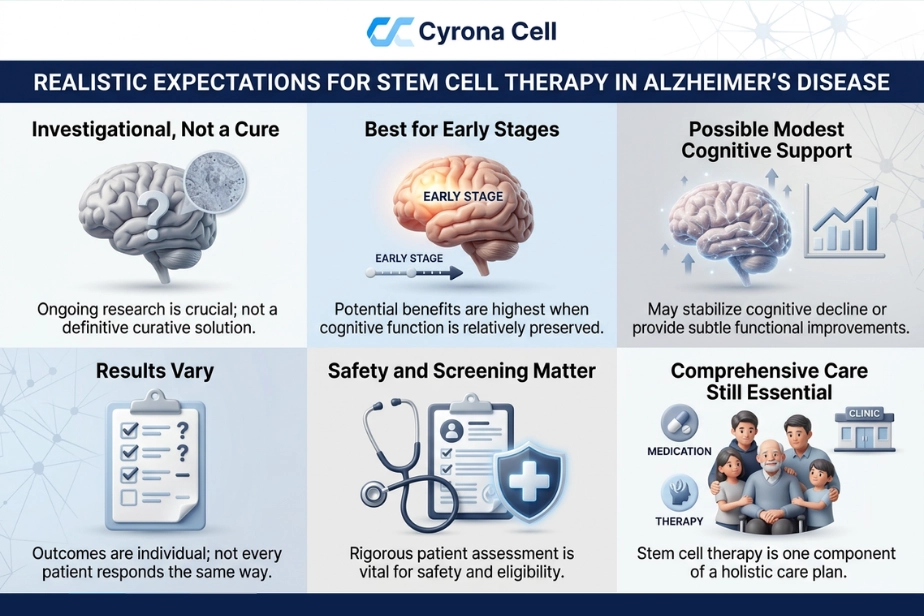
When a loved one faces Alzheimer's, families need realistic expectations for stem cell therapy in Alzheimer's disease what families need to know. Stem cell treatment uses mesenchymal stem cells mscs and other adult stem cells to release growth factors that may support brain health. However, stem cell transplantation does not cure Alzheimer's or reverse disease progression. Clinical trial data shows modest improvements in cognitive function for some early stage patients, but results vary. Families should understand side effects, candidacy requirements, and the difference between investigational treatment and proven care.
Key Takeaways for Families
Estimated read: 6 min
Keywords: realistic expectations for stem cell therapy in alzheimer's disease what families need to know, stem cell therapy, alzheimer's disease, cognitive decline, mesenchymal stem cells mscs, growth factors, clinical trial
Learn realistic expectations for stem cell therapy in Alzheimer's disease. This guide helps families understand benefits, limits, and current research.
realistic-expectations-stem-cell-therapy-alzheimers

|
Understanding benefits, limits, and long term outlook for cognitive decline
When a loved one receives an Alzheimer’s diagnosis, families search for hope. Many begin reading about new research and advanced treatment options. In this guide, Realistic Expectations for Stem Cell Therapy in Alzheimer’s Disease: What Families Need to Know, we explain what stem cell treatment may offer, what it cannot promise, and how current stem cell research shapes future care.
Alzheimer’s disease leads to progressive cognitive decline. Over time, memory, reasoning, and daily function become more difficult. Although researchers continue to explore cell therapy for alzheimer, families must understand both potential benefits and limits.
Understanding Alzheimer’s Disease and Disease Progression
Alzheimer’s disease affects brain cells that control memory and thinking. As the condition advances, amyloid plaques build up in brain tissue. These plaques disrupt communication between neurons. As a result, patients experience cognitive decline that worsens over time.
Disease progression often begins subtly in early stages. Patients may forget recent events or struggle with planning. Later, symptoms become more severe. Therefore, families often explore emerging therapies that may improve cognition or slow decline.
What Is Stem Cell Therapy for Alzheimer’s
Stem cell treatment for neurological conditions falls under regenerative medicine. Scientists study several types of stem cells for this purpose. These include mesenchymal stem cells mscs, induced pluripotent stem cells, and other adult stem cells.
Stem cell transplantation aims to introduce healthy cells that release growth factors. These growth factors may support damaged brain cells and reduce inflammation. In addition, researchers hope this approach may improve memory and improve cognition in some patients.
However, it is important to note that stem cell treatment does not currently cure Alzheimer’s disease. Instead, it remains an investigational treatment option in many regions.
Types of Stem Cells Being Studied
Researchers focus on several types of stem cells in stem cell research:
Mesenchymal stem cells mscs are widely studied because they release growth factors and may reduce inflammation.
Induced pluripotent stem cells are created from adult cells that scientists reprogram into a more flexible state.
Other adult stem cells are also evaluated in laboratory settings.
Much of this work begins in an animal model of alzheimer. These studies help scientists understand safety, dosing, and biological effects before moving to human trials.
What Clinical Trials Show So Far
A clinical trial evaluates safety and possible benefits in humans. Current clinical trial data suggest that stem cell transplantation appears generally safe in controlled settings. Some small studies report modest improvements in cognitive function. However, results vary.
Importantly, most trials focus on early stages of disease progression. Therefore, patients in advanced stages may not experience the same potential response.
Stem cell research continues, but large scale studies are still needed to confirm long term outcomes.
Potential Benefits and Realistic Limits
Families often ask whether cell therapy for alzheimer improves memory. Early findings suggest stem cell treatment may support brain cells through growth factors and anti inflammatory effects. In some cases, patients show temporary improvements in cognitive function.
However, realistic expectations matter. Current evidence does not show that stem cell transplantation reverses amyloid plaques completely. It may slow certain processes, yet it does not stop disease progression entirely.
Therefore, families should view stem cell treatment as a possible supportive treatment option rather than a cure.
| Aspect | What Stem Cell Therapy May Do | What It Does NOT Do |
|---|---|---|
| Disease Progression | May slow certain processes in early stages | Does not stop or reverse Alzheimer’s disease |
| Cognitive Function | May provide modest, temporary improvements | Does not restore normal memory or function |
| Mechanism | Releases growth factors and reduces inflammation | Does not remove amyloid plaques completely |
| Clinical Evidence | Supported by small, early-stage clinical trials | Lacks large-scale, long-term confirmation |
| Treatment Role | May be used as a supportive therapy | Not a standalone cure or replacement for standard care |
Possible Side Effects and Safety Considerations
Every medical intervention carries risks. Reported side effects of stem cell transplantation may include headache, temporary discomfort, or inflammation at the injection site. Serious side effects appear rare in controlled clinical trial settings. Still, long term safety data remain limited.
For this reason, patients should seek care from qualified medical teams who follow research based protocols.
Who May Be a Candidate
Patients in early stages of Alzheimer’s disease may be more suitable candidates. Individuals with stable health and no major uncontrolled medical conditions may qualify for certain clinical trial programs.
However, those in advanced disease progression, or those with severe systemic illness, may not be ideal candidates for stem cell treatment.
Careful screening ensures safety and appropriate expectations.
Guidance for Families Considering Treatment
Families should prioritize comprehensive care, including cognitive support, routines, and emotional guidance. Physical health, sleep, and social engagement also affect cognitive decline.
When considering regenerative medicine, families should ask about clinical trial registration, stem cell types, supporting evidence, and possible side effects to make informed decisions.
Moving Forward With Clarity and Hope
In summary, Realistic Expectations for Stem Cell Therapy in Alzheimer’s Disease: What Families Need to Know emphasizes balanced understanding. Stem cell research continues to explore how mesenchymal stem cells mscs, induced pluripotent stem cells, and other cell based approaches may improve cognition and improve memory. Yet, current evidence supports cautious optimism rather than guaranteed results.
For families facing cognitive decline, informed decisions and realistic expectations provide strength. While stem cell treatment may become a valuable treatment option in the future, comprehensive care and emotional support remain essential today.
FAQ
What advice is there for families of Alzheimer's patients?
Families should focus on education, emotional support, and structured daily routines. Because Alzheimer’s leads to cognitive decline and ongoing disease progression, long term planning is important. In addition, families should work closely with medical providers to explore every appropriate treatment option, including supportive therapies and clinical trial opportunities. If considering stem cell treatment, ask detailed questions about stem cell research, safety data, and possible side effects before making decisions.
What are the potential benefits of stem cell research for Alzheimer's patients and their families?
Stem cell research explores how cell therapy for alzheimer may support brain health. Scientists study types of stem cells such as mesenchymal stem cells mscs and induced pluripotent stem cells to see whether they release growth factors that improve cognition and improve memory. Early findings from animal model of alzheimer studies and limited clinical trial data suggest possible support for cognitive function. However, results vary, and long term benefits are still under investigation.
Who is not a good candidate for stem cell therapy?
Patients in advanced stages of Alzheimer’s disease, those with severe systemic illness, or individuals with unstable medical conditions may not be ideal candidates. In addition, people expecting a cure rather than supportive care may need counseling about realistic expectations. A full evaluation helps determine whether someone qualifies for stem cell transplantation within a regulated treatment option or research setting.