Key Takeaways
- Researchers at MUSC report that engineered mesenchymal stem cells reversed new-onset type 1 diabetes in mice, pointing to the disease’s immune response rather than just its symptoms.
- The cells were modified to overexpress a protein called alpha-1 antitrypsin, which calmed the autoimmune attack and protected insulin producing beta cells.
- This is not islet transplantation or beta-cell replacement; it is an immune-modulating approach that aims to preserve the patient’s own pancreatic islets early.
- The reversal happened in animal models. A separate human clinical trial at MUSC uses standard unmodified cells, so the engineered therapy is not yet available to patients.
- Estimated read time: 9 minutes.
New stem cell research targets the root cause of type 1 diabetes. The aim is to retrain the immune system, not just chase blood sugar. Scientists at the Medical University of South Carolina engineered mesenchymal stem cells that reversed new-onset disease in mice. Therefore, the focus has shifted from managing symptoms to protecting the body’s own insulin.
What the new research actually found
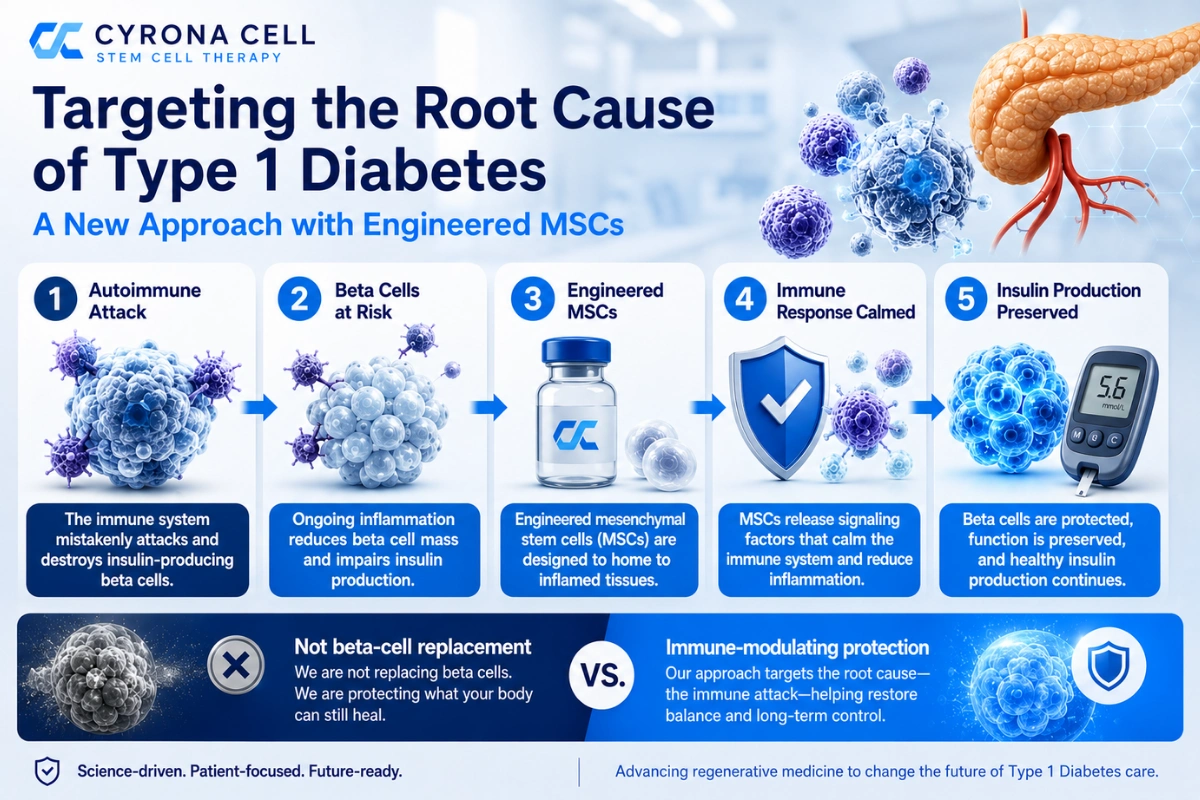
The MUSC team did not simply infuse ordinary cells. Instead, they engineered the cells to overexpress alpha-1 antitrypsin, a natural protein that dampens inflammation. Consequently, the modified cells, which the team calls AAT-MSCs, did two jobs at once.
First, they shielded the remaining insulin producing beta cells from harm. Furthermore, they reprogrammed the haywire immune response that drives the disease. This dual action paid off. A single infusion reversed diabetes in newly diagnosed mice. The team reported this in their 2026 paper in Molecular Therapy.
The path to that paper was steady. First, the group posted a preprint in 2025. Next, they presented the work as an oral abstract at the American Diabetes Association meeting. Finally, the study cleared peer review in early 2026. As a result, three separate disclosures now tell the same mechanistic story.
Why new stem cell research targets the root cause of type 1 diabetes
Type 1 diabetes is an autoimmune disease. In other words, the body’s own defense cells mistakenly destroy the beta cells that make insulin. Standard care replaces the lost insulin, yet it never stops the underlying attack.
This study takes a different route. Rather than only treating high blood glucose levels, the engineered cells aim at the autoimmune cause itself. As a result, the approach could preserve a patient’s natural insulin supply if doctors act early enough.
The science centers on immune balance. Specifically, the AAT-MSCs strengthened regulatory T cells, the “peacekeeper” cells that hold the immune system in check. Moreover, they calmed the aggressive T cells that kill beta tissue. Therefore, the pancreas continued to function in the treated animals.
The timing of treatment also matters here. The cells protect tissue rather than rebuild it, so doctors would need to act while some beta cells survive. This is why treating type 1 diabetes early, soon after diagnosis, gives the best chance of success.
How this differs from islet transplantation
Many recent headlines describe beta-cell replacement, where doctors grow new islet cells in a lab and place them in a patient. Programs from Vertex and Sana, for example, follow that path. However, the MUSC method is not the same idea.
Replacement therapy adds new cells. By contrast, this research rescues the cells a patient still has. Replacement therapy rebuilds a destroyed pancreas with new cells. By contrast, the engineered stem cell therapy tries to stop the destruction before it finishes.
This difference matters for who could benefit. The method protects surviving tissue, so it works best at the onset, when some beta cells remain. This makes it a different option from transplanting cells into late-stage patients. As a result, people with no insulin left may see little effect.
The two ideas may not stay separate forever. In theory, an immune-calming therapy could one day pair with a replacement therapy. First, the immune approach would quiet the attack. After that, transplanted cells would have a safer environment in which to survive. Although this combination remains unproven, it shows why both research camps matter.
A quick comparison of the two approaches
| Feature | Engineered MSC approach (MUSC) | Beta-cell replacement |
|---|---|---|
| Main goal | Calm the immune attack, save existing cells | Add new insulin-producing beta cells |
| Cell source | Engineered mesenchymal stem cells | Stem cell-derived islets or donor islets |
| Best candidate | Recent-onset patients | Long-standing disease |

What “reversed” means and what it does not
The word “reversed” is exciting, yet context matters. The reversal happened in female mice, not in people. Although the result is strong, animal success does not guarantee a human cure. Many promising therapies stall when they move from the lab to the clinic.
The mouse work used careful methods. For instance, the team measured blood sugar, C-peptide, and immune activity, and they mapped which cells changed. As a result, the mechanism looks solid and survived peer review. Still, it remains preclinical evidence.
Mouse models also have known limits. While the NOD mouse closely mimics human type 1 diabetes, it does not recapitulate every detail of human immunity. Therefore, scientists treat a mouse reversal as a strong signal, not as proof. Because of that gap, careful human testing must come next.
The human trial is real, but it uses different cells
Here is the key distinction many reports blur. MUSC does run a human clinical trial in recent-onset type 1 diabetes. However, that study uses standard umbilical-cord mesenchymal stem cells. It does not use the engineered AAT-MSC version from the mouse paper.
The registered study (NCT04061746) is an early phase 1 trial in adults aged 18 to 40. Its main goal is to measure whether patients keep more of their own insulin after one year. By mid-2026, enrollment showed as closed on the lab’s page, yet no public results had appeared.
As a result, two development tracks now advance simultaneously. The engineered therapy is the headline science, while the unmodified-cell trial is the bridge toward people. Therefore, readers should treat the engineered product as an early-stage product, not as an available treatment.
The trial design also explains the early-onset focus. Because doctors enroll patients soon after diagnosis, they aim to catch the disease while insulin secretion is still present. Moreover, the one-year insulin readout will show whether calming the immune system slows the loss. That result, once published, will guide the subsequent engineered work.
How does this research compare to other diabetes work?
The wider field studies several cell types. Some teams test embryonic stem cells and lab-grown stem cell derived islets to make fresh insulin tissue. In those programs, the cells differentiate into insulin producing cells that can replace what the body has lost. Others explore bone marrow and adult cells for immune repair. Each path carries its own risks and timelines.
This study fits the immune-repair camp. Because cell therapy for diabetes covers many strategies, it helps to know which problem each one solves. The MUSC work targets the attack, while replacement work targets the missing tissue. In the future, these two strategies may work together.
One more point helps readers. This research focuses on type 1 diabetes t1d, an autoimmune condition, not type 2 diabetes, which involves insulin resistance. The two diseases differ, so a single therapy rarely fits both.
Funding context rounds out the picture. The MUSC program runs on long-term federal research grants and an on-site facility built for cell-based studies. Furthermore, the team plans to expand that lab in the coming years. As a result, the project has the support it needs to keep moving, even though it stays early-stage.

What makes this finding stand out
Several details give this study weight. First, the effect came from a single infusion, not a long course of treatment. Furthermore, the cells worked in newly diabetic animals, the exact group that doctors most want to help. As a result, the finding maps cleanly onto a real clinical need.
The mechanism adds further interest. The engineered cells boosted regulatory T cells and eased the cytotoxic attack. In this way, they addressed the disease at its source. Moreover, the team confirmed those shifts through detailed immune profiling, making the story harder to dismiss as chance.
The off-the-shelf potential is another important advantage. The cells come from donor tissue rather than each patient, so a future therapy could reach more people at lower cost. However, that advantage only matters if human safety holds up, so the promise stays conditional for now.
What patients should expect today?
Caution protects patients here. Stem cell transplantation and engineered cell therapy for type 1 diabetes both show real promise. Still, no approved engineered product exists yet. Furthermore, regulators treat genetically modified cells with extra care, which lengthens the road.
Real timelines stretch years out. First, the human-bridge trial must report results. Next, the engineered version needs its own safety testing in people. Consequently, experts view approval before 2030 as unlikely, with the mid-2030s a more sober estimate.
Patients can still act sensibly today. For example, families newly facing a diagnosis should ask their care team about registered trials and proven monitoring. Meanwhile, this research offers a clear reason for hope, as it identifies the cause of the disease rather than its symptoms alone.
Cyrona’s overview of stem cell therapy for type 1 diabetes explains where the science stands today. Our guide to stem cell therapy and blood sugar control covers a related approach. For the underlying study, you can read the peer-reviewed paper in Molecular Therapy.

Frequently Asked Questions
What is the new breakthrough for type 1 diabetes?
The breakthrough is an engineered stem cell therapy that reversed new-onset disease in mice. Scientists modified mesenchymal stem cells to calm the immune response and protect insulin-producing beta cells. The goal goes beyond lowering blood glucose levels.
What is the root cause of type 1 diabetes?
The root cause is autoimmune. The immune system mistakenly attacks and destroys the pancreatic islets that make insulin. Because of this, new stem cell research targets the root cause of type 1 diabetes by retraining that faulty immune response.
Has anyone ever reversed type 1 diabetes?
Researchers have reversed it in mice, not yet reliably in people. The MUSC team reversed new-onset diabetes in animal models with a single infusion. However, human reversal through this engineered method remains unproven and needs clinical trial data.
Is this stem cell therapy available for patients yet?
No. The engineered therapy is still preclinical. A separate human trial at MUSC uses unmodified cells, and no approved engineered product exists. Therefore, patients should view this as early science, not an available treatment.