
Key Takeaways
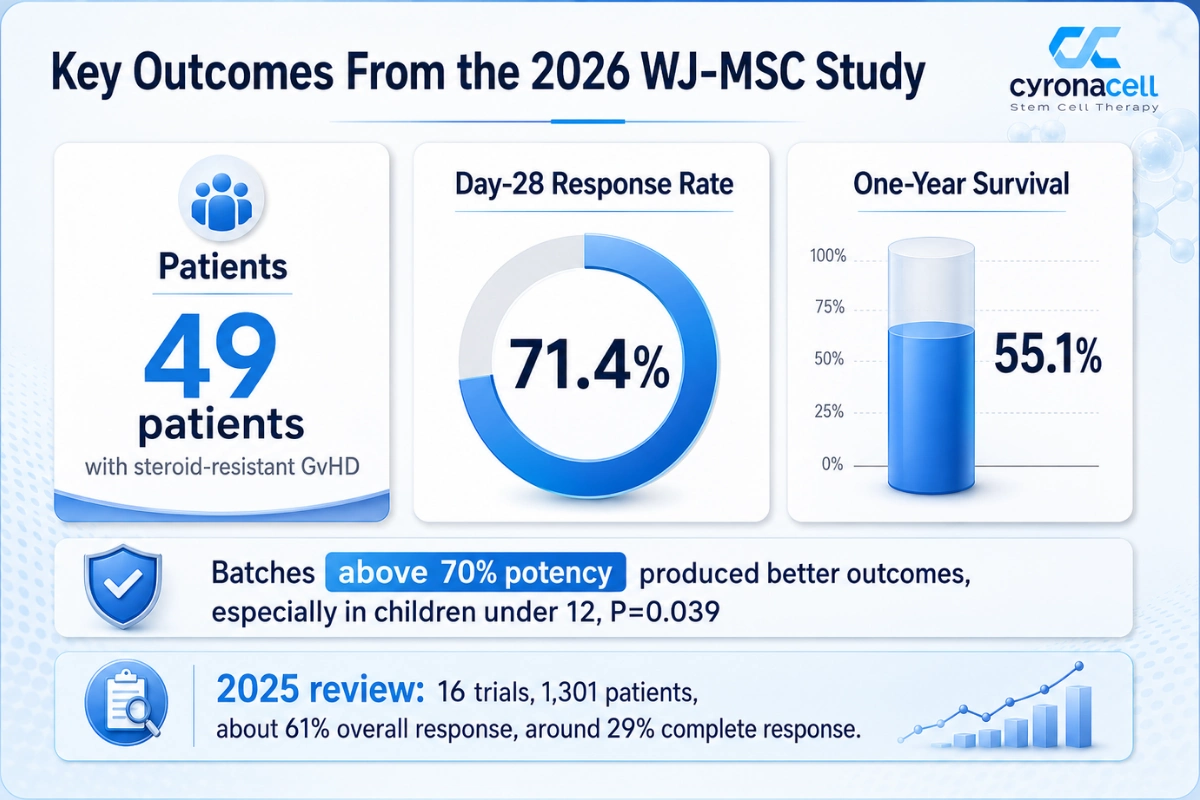
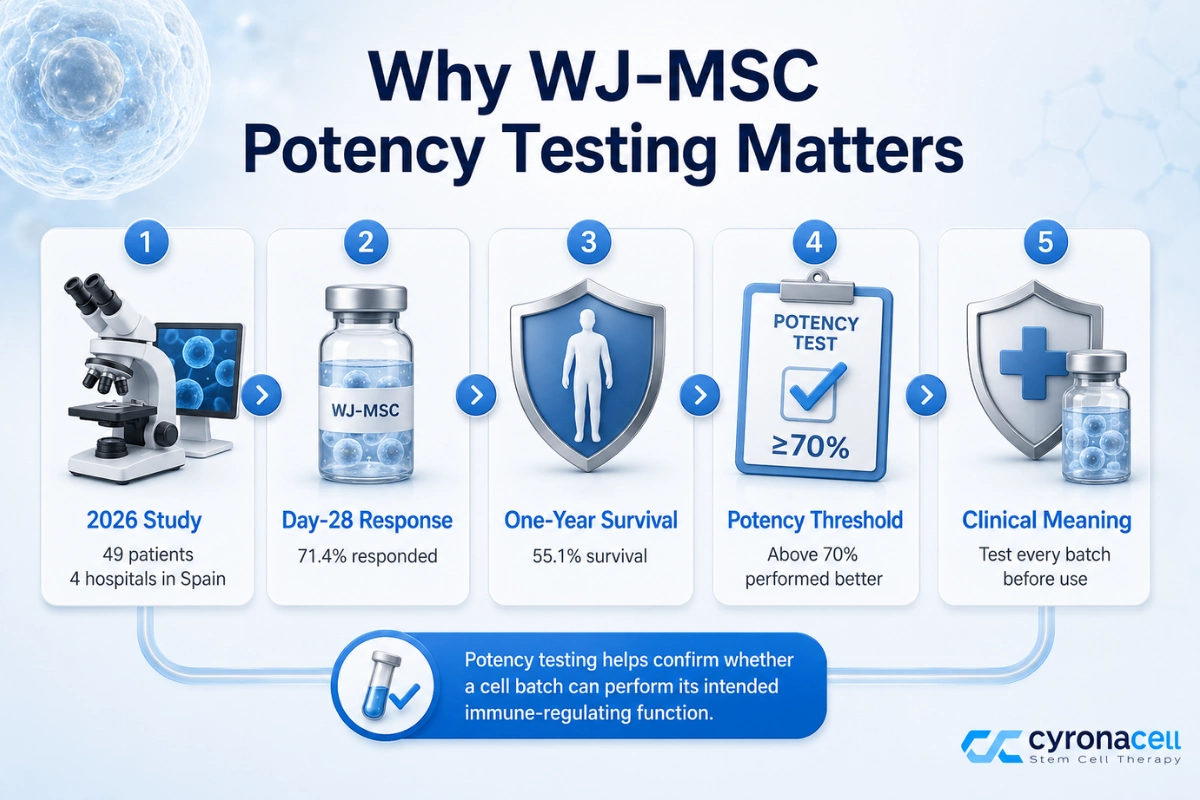
- A 2026 study in Scientific Reports followed 49 patients with steroid-resistant GvHD treated with Wharton’s jelly MSCs at four hospitals in Spain.
- At day 28, 71.4% of patients responded to treatment. One-year survival reached 55.1%.
- Batches that scored above 70% on a potency test produced far better outcomes, especially in children under 12 (P=0.039).
- The findings support making potency testing a required step before any WJ-MSC batch enters clinical use.
- Multiple 2025 reviews covering more than 1,300 patients confirm MSC response benefits, though survival gains remain inconsistent across trials.
Estimated read: 8 min
A Wharton’s jelly MSC study from June 2026 makes one clear point. Cell quality testing matters as much as which cells you use. The paper followed patients with steroid-resistant graft-versus-host disease.
In the study, researchers found that testing each batch’s potency before treatment predicted how well patients would respond. Researchers confirmed this link in children under 12 (P=0.039).
What the 2026 Wharton’s Jelly MSC Study Found
A 2026 study in Scientific Reports followed 49 patients with steroid-resistant graft-versus-host disease. All received Wharton’s jelly mesenchymal stem cells (MSCs) from donated umbilical cords. At day 28, 71.4% of patients responded to treatment.
Furthermore, one-year survival reached 55.1%. Batches that scored above 70% on a potency test produced far better results, especially in children under 12.
Specifically, the paper drew patients from four hospitals in Spain between 2018 and 2022. Each had already failed standard steroid treatment before joining. In total, 40 had acute GvHD and nine had chronic GvHD.
Each patient received WJ-MSCs from donated umbilical cord tissue at a dose of 1×10^6 cells per kilogram. Most received four infusions, given on days 1 and 4, followed by once-weekly dosing. Notably, responders in the acute GvHD group survived significantly longer than non-responders (P=0.012).
Therefore, the research team concluded that potency should be a formal release step. This means every batch should pass a potency test before entering clinical use. The full findings appear in a 2026 Scientific Reports paper on the potency of WJ-MSCs in steroid-resistant GvHD.
Why Wharton’s Jelly MSCs Differ From Other Cell Sources
Mesenchymal stem cells (MSCs) come from several tissue sources. For many years, clinicians used bone marrow as the main source. Many approved products still rely on it today.
Since then, adipose tissue, placenta, and Wharton’s jelly have also entered clinical use. Wharton’s jelly is the connective tissue inside the umbilical cord.
Hospitals collect donated umbilical cords after birth. This carries no risk for the mother or infant. The jelly-derived cells from this tissue grow well in the lab.
This matters when manufacturers need large quantities to treat multiple patients. Furthermore, these cells tend to show strong immune-suppressing profiles across studies.
WJ-MSCs also avoid the ethical concerns tied to embryonic stem cells. Embryonic stem cell research destroys a fertilized embryo. This has allowed WJ-MSC programs to advance in settings where embryonic stem cell research is legally restricted.
Additionally, WJ-MSCs have shown consistent immune-suppressing activity across multiple studies. Researchers are also testing them for conditions such as joint pain and autoimmune disease. For a closer look at the clinical process, see how stem cell therapy works at Cyrona Cell.

What the Potency Assay Measures and Why It Matters
A potency assay is a test with one purpose: confirming that a batch of cells can carry out its intended function. For WJ-MSCs used in immune conditions, the function is to suppress an overactive immune system.
The MLR test does this by combining immune cells in a lab. It records how well the batch reduces its activity.
MSC infusion affects the immune system through multiple pathways simultaneously. MSCs produce signals that reduce inflammation. They also reduce harmful T-cell activity and promote the development of protective regulatory T cells.
In practice, a high-potency batch performs all these functions effectively. However, a lower-potency batch may pass basic release checks, such as cell count and cell viability. It may still lack the function needed to help patients.
Research into what MSCs release also supports this finding. A review of WJ-MSC secretome components and their therapeutic potential found a key insight. Most of how these cells help the body comes from what they release, not from replacing tissue.
In other words, MSCs act primarily by releasing particles and signaling proteins that alter the local environment. Consequently, tests that measure this release activity give a more meaningful quality signal than standard checks alone.
Other researchers have also studied exosome- and secretome-based approaches to cell therapy. They explore how clinicians can apply these signaling particles without whole-cell infusions.

How This Research Fits the Broader Evidence Base
Notably, this Wharton’s jelly MSC study is not an isolated study. A 2025 review by Khalifa and colleagues pooled data from 16 trials involving 1,301 patients. The overall response rate was about 61%.
Complete response reached around 29%. Patients who received four or more infusions within 28 days did better. They achieved a 64% response rate and a 40% one-year survival rate.
This points to dosing frequency as another key factor alongside batch quality. Also, a separate 2025 review by Khan and colleagues examined four controlled trials involving 650 patients.
MSCs significantly outperformed controls in overall response (risk ratio of approximately 1.13) and complete response (risk ratio of approximately 1.60). The benefit was strongest in severe, multi-organ disease.
However, no clear survival benefit emerged. This pattern has appeared in multiple MSC studies in regenerative medicine.
In December 2024, the FDA approved remestemcel-L, sold as Ryoncil, as the first approved MSC therapy in the US. The FDA cleared it specifically for pediatric SR-GvHD.
This approval rested on a day-28 response rate of 70.4% and a much better 100-day survival in those who responded.
This prompted regulators to consider how to define potency in future MSC product approvals. Clinicians treating autoimmune and immune-related conditions, including rheumatoid arthritis and related immune disorders, are closely monitoring this evidence.

Questions This Body of Evidence Still Leaves Open
However, response rates across MSC trials remain consistently in the 60-70% range at day 28. These rates do not yet lead to clear long-term survival gains. This gap is the most discussed challenge in the field.
GvHD management ultimately aims for long-term disease control. Short-term response rates, however consistent, do not fully answer that question.
Moreover, the differences between trials limit what we can conclude. Studies differ in cell source, dose, infusion schedule, and whether teams gave MSCs alone or alongside other agents. For example, research programs in China, Europe, and North America use different manufacturing standards.
Additionally, the best MSC source remains unclear. Bone marrow, umbilical cord, and adipose MSCs may all suppress the immune system differently. They also vary from batch to batch.
As a result, standardized potency testing offers one way to resolve these differences. However, this only works when all trials use the same methods. They also need to report results in a way that allows comparison.
What Researchers Are Now Proposing
The most direct next step from the Vives study is a prospective controlled trial. This would compare high-potency and low-potency WJ-MSC batches with all other factors held constant. Such a trial would confirm whether this potency-response link holds in a controlled setting.
Currently, no published trial of this exact design is underway. However, the argument for it is now formally in the peer-reviewed literature.
In parallel, engineered MSCs have also emerged as a research direction. A June 2026 study by Uchibori and colleagues engineered umbilical cord MSCs to release a protein called PD-L1. This protein is better known from cancer research, where it helps tumor cells avoid the immune system.
In a lab model, these modified cells reduced human T-cell activity. This shows that engineered cells could offer more consistent immune regulation than naturally variable batches.
Also, early work in induced lung injury models has shown that MSCs can affect inflammation and help reduce fibrosis. This suggests the potency-response principle may extend beyond GvHD.
Furthermore, comparing the profiles of patients who respond and those who do not could help find useful markers. These could predict benefit before treatment starts. This kind of patient sorting is already standard in cancer immune treatment.
Ultimately, the goal is consistent and verified therapeutic potential. This covers the cell product, the manufacturing process, and the evidence base.
The promise of MSC therapy for tissue regeneration and immune regulation is real. Making that promise repeatable is the remaining challenge.

Frequently Asked Questions
What are Wharton’s jelly-derived mesenchymal stem cells?
Wharton’s jelly is the soft tissue inside the umbilical cord. Mesenchymal stem cells (MSCs) taken from this tissue are a type of adult stem cell. They have strong immune-suppressing properties.
Parents donate the cord after birth, at no risk to the mother or infant. WJ-MSCs raise none of the ethical concerns linked to embryonic stem cells.
Because of this, WJ-MSCs have become one of the most studied sources for immune conditions. These include steroid-resistant graft-versus-host disease.
What does a potency assay measure in WJ-MSC therapy?
A potency assay assesses whether a batch of cells can perform its intended function. For WJ-MSCs used in immune conditions, the job is to suppress the immune system.
The MLR test does this by combining immune cells and recording how well the batch reduces their activity. Results from the 2026 Wharton’s jelly MSC study show a clear pattern.
Batches above 70% on the MLR test produced significantly better outcomes than those in the 30-70% range. This supports using the potency score as a formal release step.
How is graft-versus-host disease related to stem cell transplantation?
Graft-versus-host disease can follow an allogeneic cells transplant. This includes bone marrow or blood stem cell transplants. It develops when donor immune cells see the recipient’s tissues as foreign and attack them.
Specifically, steroid-resistant GvHD is the form that does not respond to standard steroid drugs. MSC therapy has become one of the most studied second-line options in this setting.
Together, MSCs produce signals that reduce inflammation. These may help reduce fibrosis and calm damaging immune responses without adding the burden of more drug treatment.
Could this research apply to conditions beyond GvHD?
The potency-response principle from this Wharton’s jelly MSC study has wider implications. If a pre-treatment potency score predicts response in GvHD, the same logic could apply to other conditions. For instance, these include autoimmune disease, organ repair, and other areas where researchers are actively studying MSCs.
Standardizing potency testing across MSC programs would give regulators a clear framework for comparing products. GvHD has provided some of the clearest clinical evidence for this approach. Therefore, the next step is to extend this quality standard more broadly across regenerative medicine.