Key Takeaways
- Two phase 3 trials tested the same stem cell injection for complex Crohn’s perianal fistulas, separated by a decade.
- The first trial, ADMIRE-CD, showed a clear benefit and led to European approval in 2018.
- ADMIRE-CD II, a much larger follow-up trial, enrolled 568 patients and found no real difference from placebo.
- The European Union withdrew the drug’s approval in December 2024, and Japan discontinued sales in January 2026.
- Standard care, biologics plus surgical drainage, remains the main path for most patients.
Estimated read: 8 minutes
Two phase 3 trials tested the same treatment for Crohn’s perianal fistulas, a decade apart. The first led to a European drug approval.
The second reached a different conclusion. This article explains what changed and what it means for patients today.
What Makes a Trial “Phase 3”?
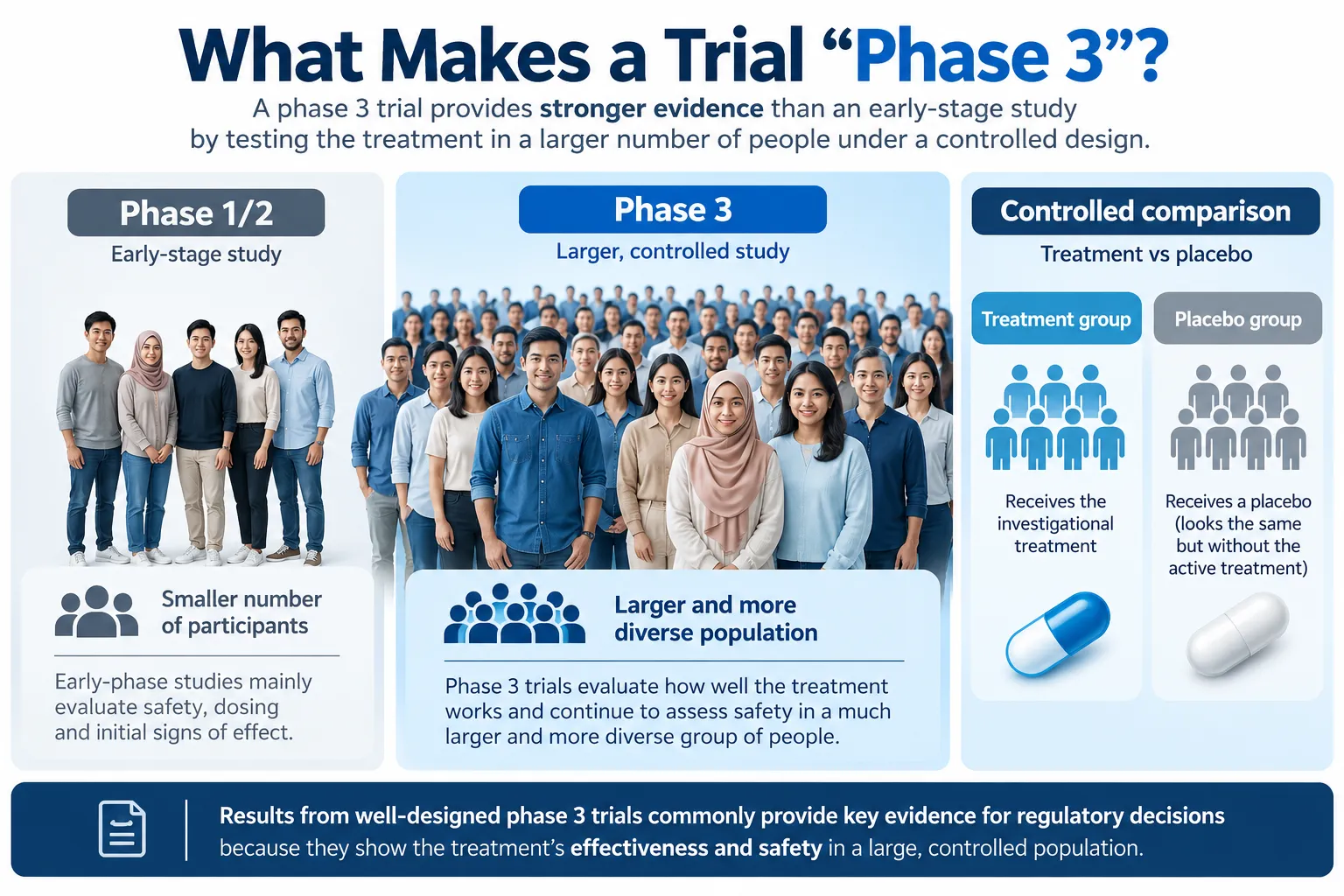
A phase 3 clinical trial tests a treatment in a large group of patients, often several hundred. Researchers compare the results directly against a placebo. Regulators then use this stage to decide whether to approve a therapy for public use.
Complex perianal fistulas are hard to treat. For this reason, phase 3 evidence carries the most weight of any research stage.
Smaller phase 1 and phase 2 studies can look promising, but they usually involve only a few dozen patients. As a result, early findings can mislead until a larger trial confirms them.
Regulators in Europe, Japan, and the United States generally expect a successful phase 3 trial before approval. This requirement exists because smaller, earlier studies do not always predict what happens at scale. A treatment that looks strong in 20 patients can behave differently in 500.
How the Injectable Stem Cell Treatment Works
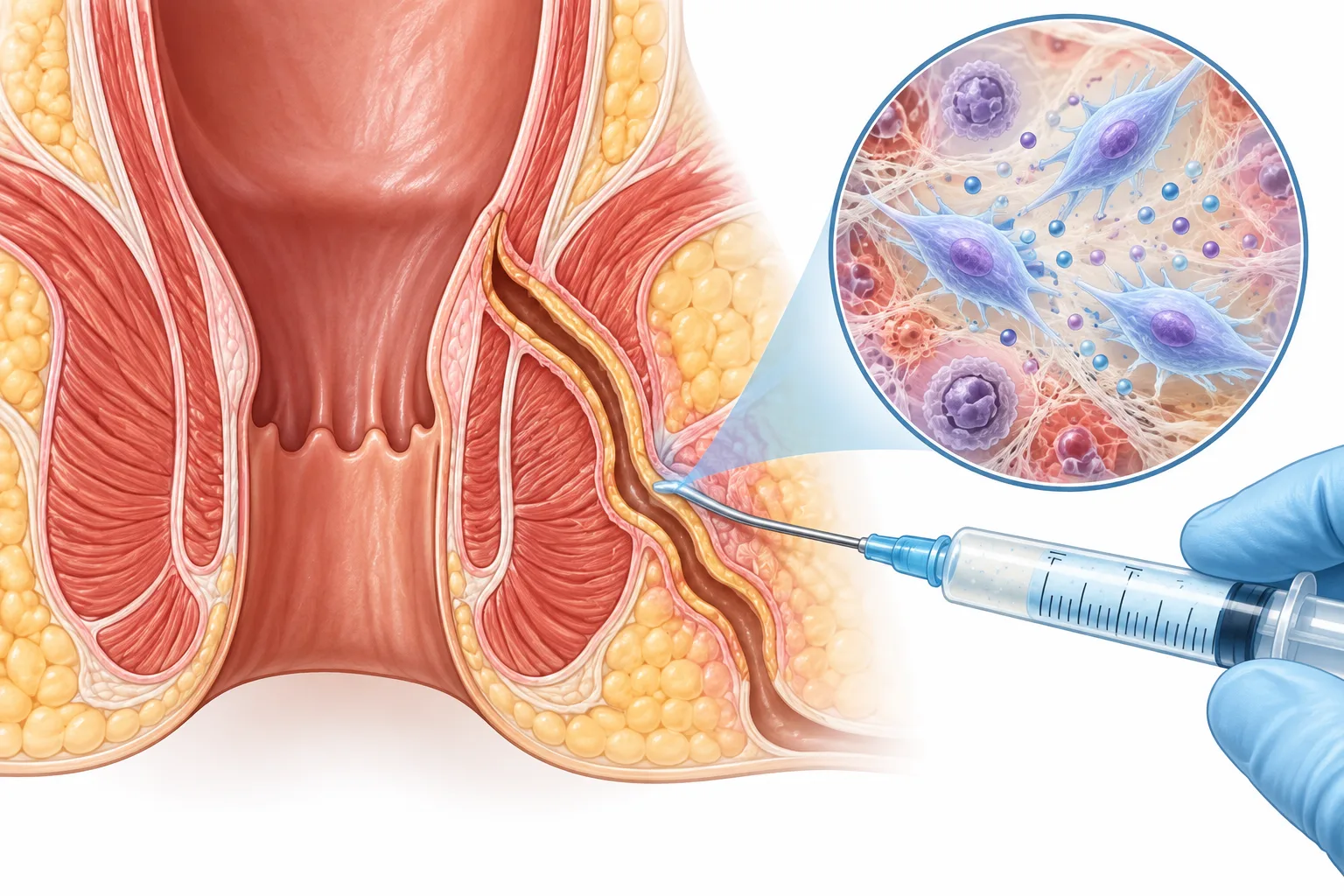
The therapy tested in both trials is darvadstrocel, sold under the brand name Alofisel. It uses adipose derived stem cells, taken from a donor’s fat tissue and expanded in a lab.
Surgeons first prepare the fistula tract. Then, in the same short procedure, they inject the cell suspension directly around it.
The cells do not rebuild tissue on their own. Instead, they release signals that calm local inflammation. This, in turn, supports the closure of external openings that keep draining.
Cyrona Cell’s own overview of stem cell treatment for Crohn’s disease covers this mechanism in more detail. A separate article looks at when this option is worth considering: stem cell treatment for Crohn’s disease beyond biologics.
The procedure itself usually happens under local or regional anesthesia in an outpatient setting. Most patients return home the same day. However, full fistula closure can take weeks to appear, since the treatment works gradually.
Donor cells go through screening for infectious disease and genetic markers before use. This screening process is standard across allogeneic cell therapies, not something unique to darvadstrocel.

Who Actually Enrolled in These Trials
Both trials focused on adults with complex perianal fistulas linked to Crohn’s disease. In practice, this meant the fistula tract crossed a large part of the sphincter muscle. Some also reached more than one external opening.
Both studies excluded simple, low fistulas.
Most participants were adults aged 18 to 75 years. This range reflects how long complex fistulas typically take to become treatment-refractory.
Participants also needed non-active or only mildly active luminal Crohn’s disease at enrollment. In other words, both trials tested fistula healing specifically, not overall disease control. So, someone with active flares elsewhere in the bowel would not have qualified.
Every participant had already tried at least one conventional or biologic therapy first, without lasting success. This detail matters, because it defines exactly who this evidence applies to. It says little about first-line treatment, or about fistulas that no one has treated yet.
What the First Phase 3 Trial on Crohn’s Perianal Fistulas Found
The original ADMIRE-CD trial enrolled 212 adults across Europe and Israel. All had complex perianal fistulas linked to non-active or mildly active Crohn’s disease. Notably, every one of them had already tried at least one prior therapy.
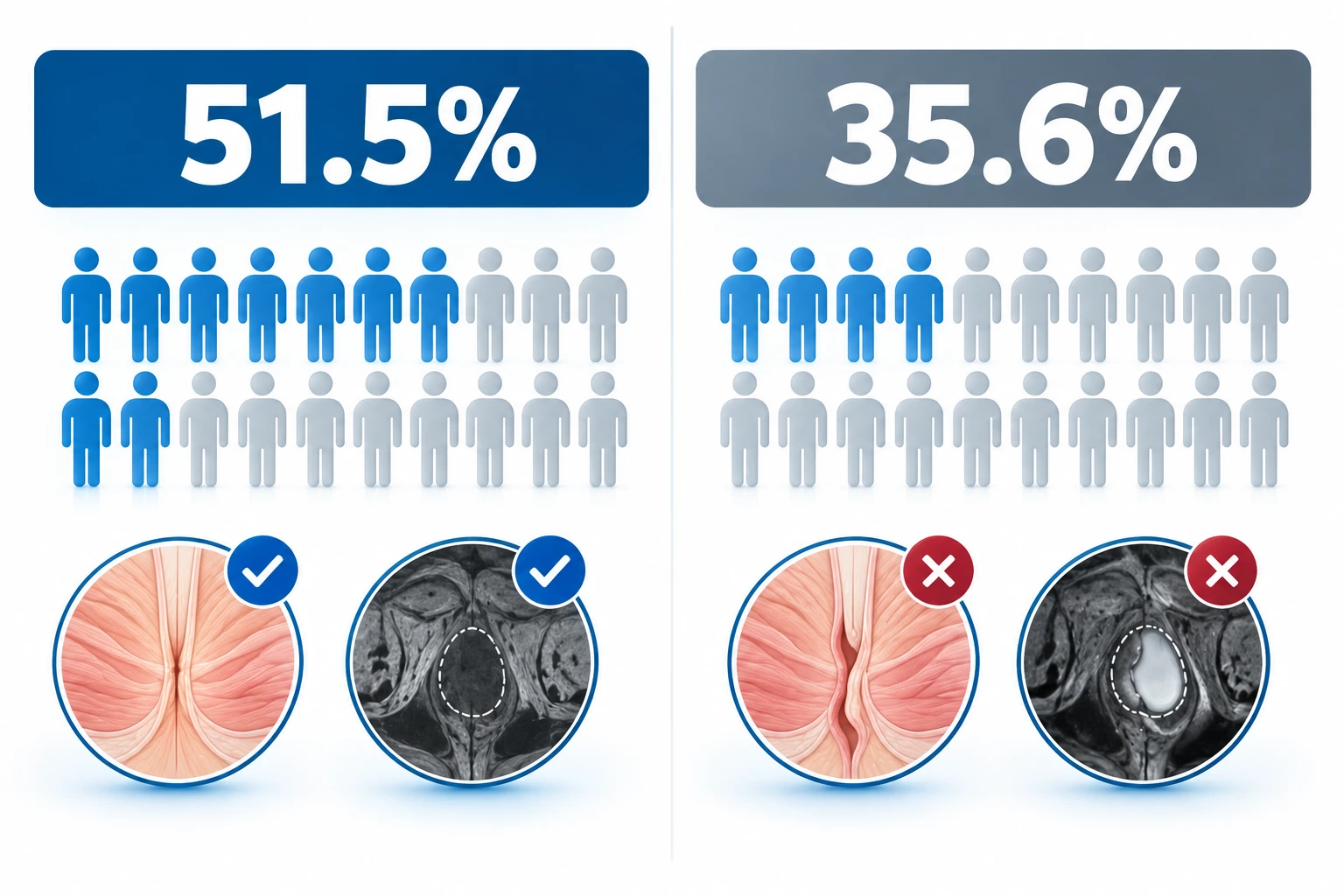
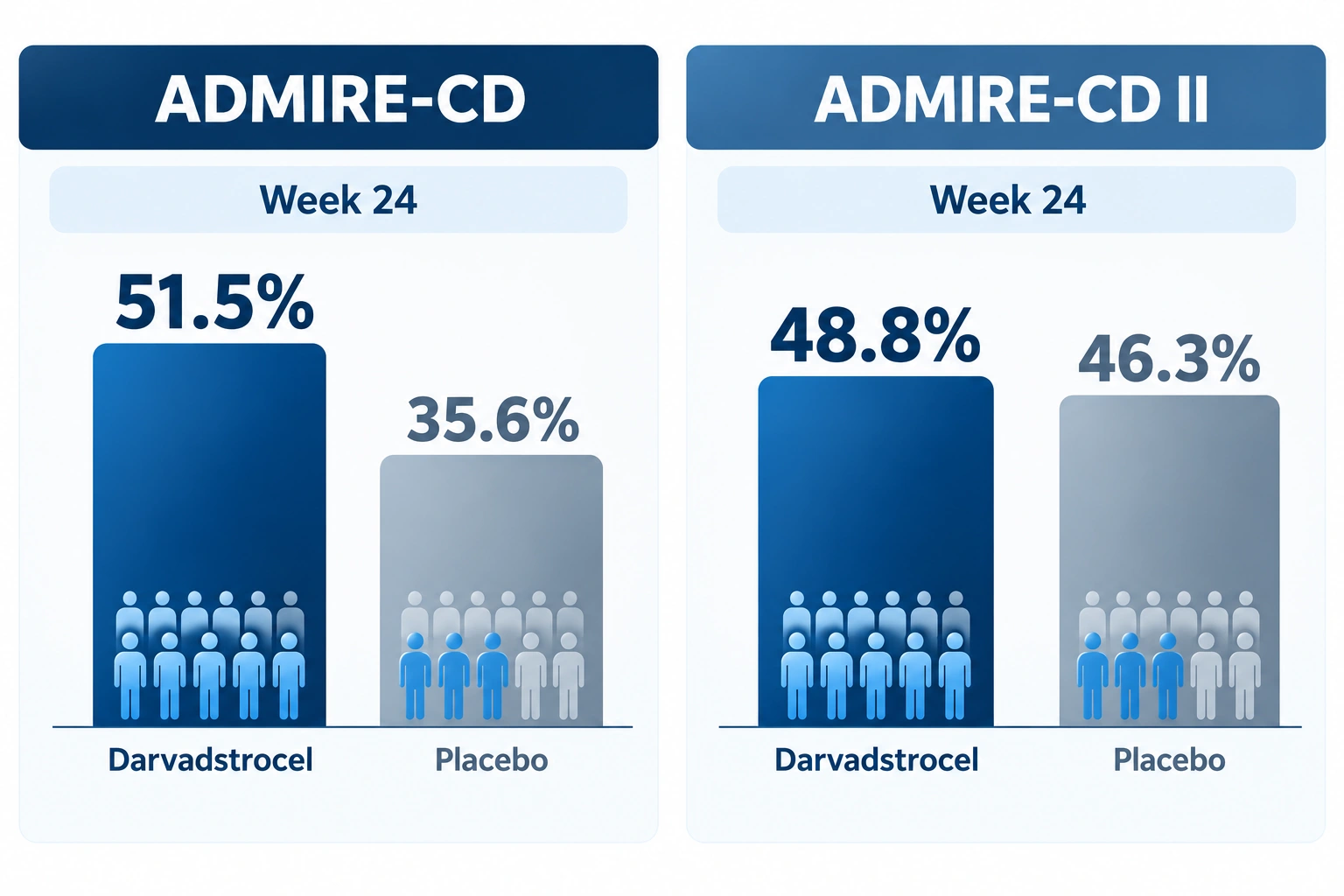
At 24 weeks, 51.5% of patients on darvadstrocel reached combined remission, compared with 35.6% on placebo. Combined remission meant every treated external opening had closed, with no fluid collection larger than 2 centimeters. Researchers considered this gap large enough to matter, and the benefit held up through 52 weeks.
Based on these results, the European Commission approved Alofisel in March 2018. It became the first allogeneic stem cell therapy ever approved in the European Union. Regulators later cleared it in Japan, Israel, Switzerland, Serbia, and the United Kingdom too.
The Follow-Up Trial That Told a Different Story
The follow-up trial, ADMIRE-CD II, found no meaningful difference between darvadstrocel and placebo. At 24 weeks, combined remission occurred in 48.8% of patients on darvadstrocel, versus 46.3% on placebo. That gap was too small to matter.
Regulators had asked for this larger follow-up study before finalizing long-term approval. The trial enrolled 568 patients across Europe, Israel, and North America, nearly triple the size of the original.
At 52 weeks, the pattern held steady, at 41.0% versus 39.7%. None of the secondary endpoints showed a real benefit either, per results published in a leading digestive-disease journal.
| Trial | Darvadstrocel remission (Week 24) | Placebo remission (Week 24) | Statistically significant? |
|---|---|---|---|
| ADMIRE-CD (2016) | 51.5% | 35.6% | Yes |
| ADMIRE-CD II (2026) | 48.8% | 46.3% | No |

Why the Placebo Group Responded So Well
The darvadstrocel group performed similarly in both trials. The placebo group, however, changed.
In the original study, only about a third of placebo patients reached remission. A decade later, nearly half did.
Investigators pointed to broad gains in standard care over that decade. Newer biologic combinations and better surgical technique likely lifted outcomes for everyone in the trial.
This applied to placebo patients too, not only those who got the injection. Consequently, the treatment’s added value became much harder to detect.
Where the Approved Therapy Stands Today
The follow-up trial results led to a formal regulatory response. Takeda, the manufacturer, requested withdrawal of Alofisel’s market approval.
Afterward, the European Medicines Agency withdrew it from the EU market on 13 December 2024. Regulators said its clinical benefit no longer justified continued use.
Japan initially kept Alofisel available after its own 2021 approval. In January 2026, Takeda announced it would discontinue sales in Japan as well.
This effectively ended the product’s availability in every major market where it once held approval. Still, this does not mean every avenue for inflammatory bowel disease cell therapy has closed.
Cyrona Cell’s stem cell therapy for inflammatory bowel disease uses umbilical cord derived cells instead. This is a different cell source from the adipose derived product studied here. It has its own separate body of evidence.
In fact, researchers have not abandoned the broader idea of cell therapy for fistulas. Several smaller academic trials using umbilical cord derived or bone marrow derived cells remain active. None has yet matched the scale of ADMIRE-CD II.
For patients researching options from Malaysia or Southeast Asia, this news matters less than it first appears. Regulators never reviewed darvadstrocel for approval in this region, so it was rarely available here in the first place.
What This Means for Crohn’s Perianal Fistulas Today
For most patients with perianal Crohn’s fistulas, the practical starting point has not changed. Standard care still combines biologic medication with surgical seton drainage to control infection while the fistula heals.
Surgery alone rarely closes a complex fistula for good, since cutting the tract risks the sphincter muscle. That is why surgeons typically place a seton, a soft drain, first. Cell-based therapy, when used at all, sits alongside this combination rather than replacing it.
If you are exploring cell-based options anyway, a few questions are worth asking first. Cost, travel, and follow-up logistics matter too, alongside the clinical evidence itself.
- Which specific cell product or cell source does the clinic use, and is it the one studied in large trials?
- What does the published evidence show for that exact product, not just for stem cells in general?
- How does the clinic monitor safety during and after treatment?
- What would count as a realistic outcome, given your fistula’s grade and history?
Even so, research on other MSC sources continues. Studies on umbilical cord derived cells for related bowel conditions are ongoing.
One example looks at how umbilical cord MSCs may influence inflammation in ulcerative colitis. None of this current research claims to offer a cure.
Considering whether a stem cell evaluation makes sense for your case? Message the Cyrona Cell team on WhatsApp to talk through your fistula history and current treatment plan.
Frequently Asked Questions
What is a grade 3 perianal fistula?
A grade 3 perianal fistula is a transsphincteric fistula, under the St James’s University Hospital MRI grading system. It starts in the anal canal. From there, it passes through both the internal and external sphincter muscles to reach the skin.
This grade sits in the middle of a five-grade scale. It often needs specialist surgical planning rather than a simple surgical cut. Grades 4 and 5, by comparison, involve abscess formation or extension above the pelvic floor.
How serious is perianal Crohn’s disease?
Perianal Crohn’s disease is generally one of the more difficult forms of the condition to manage. Complex fistulas carry a real risk of recurring abscesses, incontinence, and repeated surgery. Without treatment, these fistulas rarely close on their own.
Because of this, most digestive-disease specialists involve a colorectal surgeon early. Regular MRI monitoring, along with close coordination between both specialists, usually gives the best long-term results.
Are stem cells getting closer to solving Crohn’s perianal fistulas?
The evidence has not moved in a straight line. Darvadstrocel had the strongest single body of evidence. Yet it lost approval after a larger trial failed to confirm the earlier benefit.
Research on other cell sources continues, but no stem cell treatment currently cures Crohn’s disease. Ongoing trials are testing newer cell sources and delivery methods, so this evidence base is still evolving, not settled.
What is the most effective treatment for perianal Crohn’s disease?
No single treatment suits every patient. Most specialists combine biologic therapy with surgical drainage, using a seton to keep the tract open while inflammation settles.
Treatment choice ultimately depends on fistula complexity, prior response to medication, and overall disease activity. Newer biologic classes, including anti-integrin and anti-IL-23 drugs, sometimes help when anti-TNF therapy alone falls short.

Talk to a Doctor About Your Options
Every case of Crohn’s perianal fistulas looks different. The right next step depends on details a blog post cannot capture. Submit your case for a free medical review and get a doctor’s honest read on where you stand.