
Key Takeaways
- A new 2026 study found a molecule called OLE that appears to reprogram the brain’s immune cells, restoring part of their protective role against Alzheimer’s.
- In treated animals, these cells surrounded beta-amyloid plaques, shrank them, and helped remove amyloid beta plaques from brain tissue.
- Mice on the treatment performed better on memory tests, suggesting the approach may slow cognitive decline.
- The research is early and based on worms and mice, so it is not yet a treatment for people.
- Scientists from Spain and Switzerland published the work in the journal Cell Death and Disease.
Estimated read time: 5 minutes
A new 2026 study suggests the brain’s own defense cells can fight Alzheimer’s again. Researchers in Spain and Switzerland found a molecule that appears to reprogram Alzheimer’s brain immune cells. The molecule helps these cells surround toxic plaques and shield nearby neurons. Here is what families should understand about this early finding.
What the New 2026 Study Discovered
Researchers found an experimental molecule called OLE. It restores the protective role of microglia, the brain’s immune cells. In animal models, OLE helped these cells surround beta-amyloid plaques, reduce their size, and improve memory. The work points to a fresh way to treat brain damage linked to Alzheimer’s.
The study appeared in the journal Cell Death and Disease. A team in Spain led the work, in collaboration with researchers in Switzerland. José Vicente Sánchez Mut headed the Spanish group, alongside Johannes Gräff at EPFL in Lausanne.
Furthermore, the molecule is encoded by a gene called PM20D1. Earlier research had already linked this gene to Alzheimer’s. As a result, the team had a clear target to test.
Two European patents now cover the findings, which the researchers say support future work.
Why the Brain’s Immune Cells Lose Their Edge
One hallmark of Alzheimer’s is the buildup of sticky beta-amyloid plaques. Normally, the brain’s immune system keeps these deposits in check. Microglia, the immune cells called the brain’s clean-up crew, patrol tissue and clear waste.
However, as Alzheimer’s disease develops, these cells gradually stop working well. Consequently, plaques spread and begin to harm neurons.
When this happens, almost every immune cell in the brain shifts from helper to bystander. Therefore, restoring that lost function has become a major research goal. The new study tackles exactly this problem.
How OLE Reprograms Alzheimer’s Brain Immune Cells
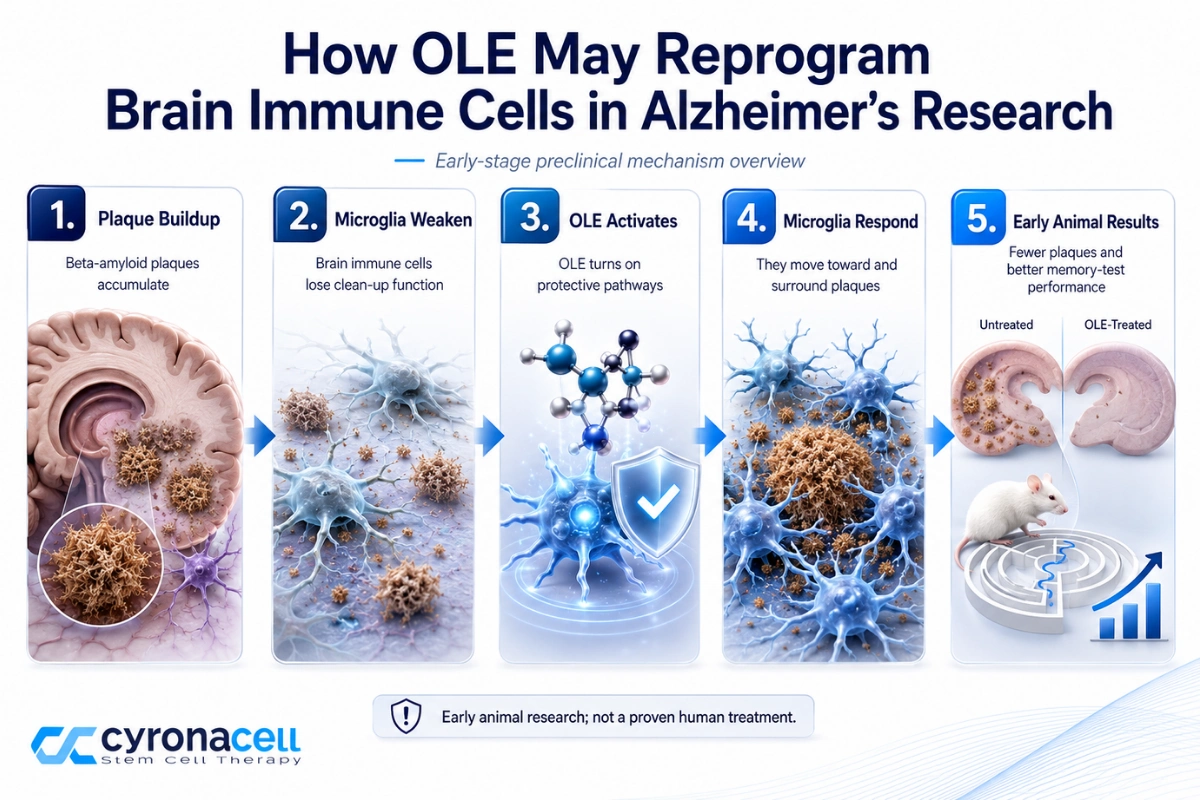
After OLE treatment, the microglia moved toward beta-amyloid plaques and wrapped around them. In effect, they built a barrier that limited contact between the plaques and nearby brain cells. This reduced the harm caused by the plaques.
To understand the change, the researchers studied thousands of single cells. Notably, microglia responded to the molecule far more strongly than any other cell type.
Following exposure to OLE, these cells switched on pathways that clear amyloid. They also regained their ability to move toward plaques. In short, the molecule did not replace the cells; instead, it woke up the ones already there.

What Researchers Found in Worms and Mice
First, the team tested OLE in tiny worms engineered to produce beta-amyloid. Because these worms develop damage quickly, they offer a fast way to study toxicity. After treatment, the worms built up fewer protein clumps and moved better.
Next, the researchers gave OLE to mice with an Alzheimer ‘s-like condition for three months. Afterward, the treated mice performed better on memory tests than the untreated mice. They also showed fewer plaques in the brain.
Moreover, separate cell-based experiments suggested that OLE may directly protect neurons. This effect went beyond the immune response. Together, these results across several models strengthen the case for further study.
What the Findings Could Mean Going Forward
This work offers hope, yet it remains early. So far, scientists have tested OLE only in worms, mice, and lab-grown cells, not in people. Naturally, questions about dosing, safety, and potential side effects still need to be answered before any human trial.
Even so, the approach is promising because it works with the body, not against it. Rather than only clearing plaques, the molecule rebuilds the brain’s natural defense. If the effect holds up in humans, it could one day help slow cognitive decline.
This idea fits a wider trend in the field. Many teams now study the brain’s immune system as a treatment target. According to the Alzheimer’s Association, immune-focused approaches are a fast-growing area of dementia research.
For families following these advances, this study marks a steady shift toward repairing the brain’s own defenses. For more background, see how Alzheimer’s disease and cell-based research connect. You can also read the original report on ScienceDaily.
| Study Finding | What Researchers Observed | Potential Significance |
|---|---|---|
| OLE Molecule | Reactivated microglia, the brain’s immune cells | May restore natural brain defense mechanisms |
| Beta-Amyloid Plaques | Microglia surrounded and reduced plaque size | Could help limit damage to nearby neurons |
| Memory Performance | Treated mice performed better on memory tests | Suggests possible slowing of cognitive decline |
| Single-Cell Analysis | Microglia showed the strongest response to OLE | Supports immune-cell targeting as a therapy strategy |
| Animal Models | Positive results seen in worms and mice | Provides justification for future human studies |
| Current Status | No human clinical trials have begun | Research remains experimental |

Frequently Asked Questions
How do you remove plaque from the brain of Alzheimer’s patients?
Currently, doctors use a few antibody drugs that help remove amyloid beta plaques. However, the benefits are modest, and real risks exist.
This new 2026 study takes a different route. Instead of attacking plaques directly, OLE prompts the brain’s immune cells to contain and clear them. The method is still experimental and not yet available.
What are microglia, and why do they matter?
In short, microglia are immune cells called the brain’s first responders. They clear waste, fight infection, and support healthy neurons.
However, as Alzheimer’s progresses, these cells lose function, which allows plaques to build up. Therefore, restoring them is the core idea behind this research.
Is the OLE treatment available now?
Not at this stage. So far, researchers have tested OLE only in worms, mice, and cell cultures. Human trials have not started.
Therefore, the molecule cannot yet treat brain disease in people. For now, the findings guide future work.
Could reprogramming immune cells reverse Alzheimer’s?
Possibly, but it is too soon to say. The animal results show that some loss of microglial function may be reversible.
Still, reversing the full disease in humans is a far greater challenge that will require years of study. For a grounded view, see these realistic expectations for cell-based therapy.