
Key Takeaways
- A 2024 network meta-analysis of 48 studies ranked PRP highest for knee osteoarthritis pain and function, followed by a bone marrow cell-based option, then hyaluronic acid (HA).
- The cell-based option’s ranking rests on far fewer studies (2.5% of the pooled evidence) than HA’s ranking (nearly 41%), so that result carries more uncertainty.
- A separate analysis found bone marrow derived stem cells significantly improved pain scores compared with HA directly, though stem cell injections also showed more reported side effects.
- HA and PRP typically cost less and have a longer track record than stem cell therapy, which more often comes up after those options stop working.
- No current option regrows cartilage or guarantees results. Most benefit centers on pain relief and function, and a physician’s review of imaging and history matters more than any single ranking.
Estimated read: 8 min
Knee osteoarthritis patients now face three common injection options, not just one. Overall, stem cells, PRP, and hyaluronic acid all promise pain relief.
However, the evidence behind each looks different once you compare them directly. A 2024 study ranked these options against each other for the first time at this scale.
The findings below explain what that comparison actually found. Genuine uncertainty remains for stem cells vs PRP or HA specifically.
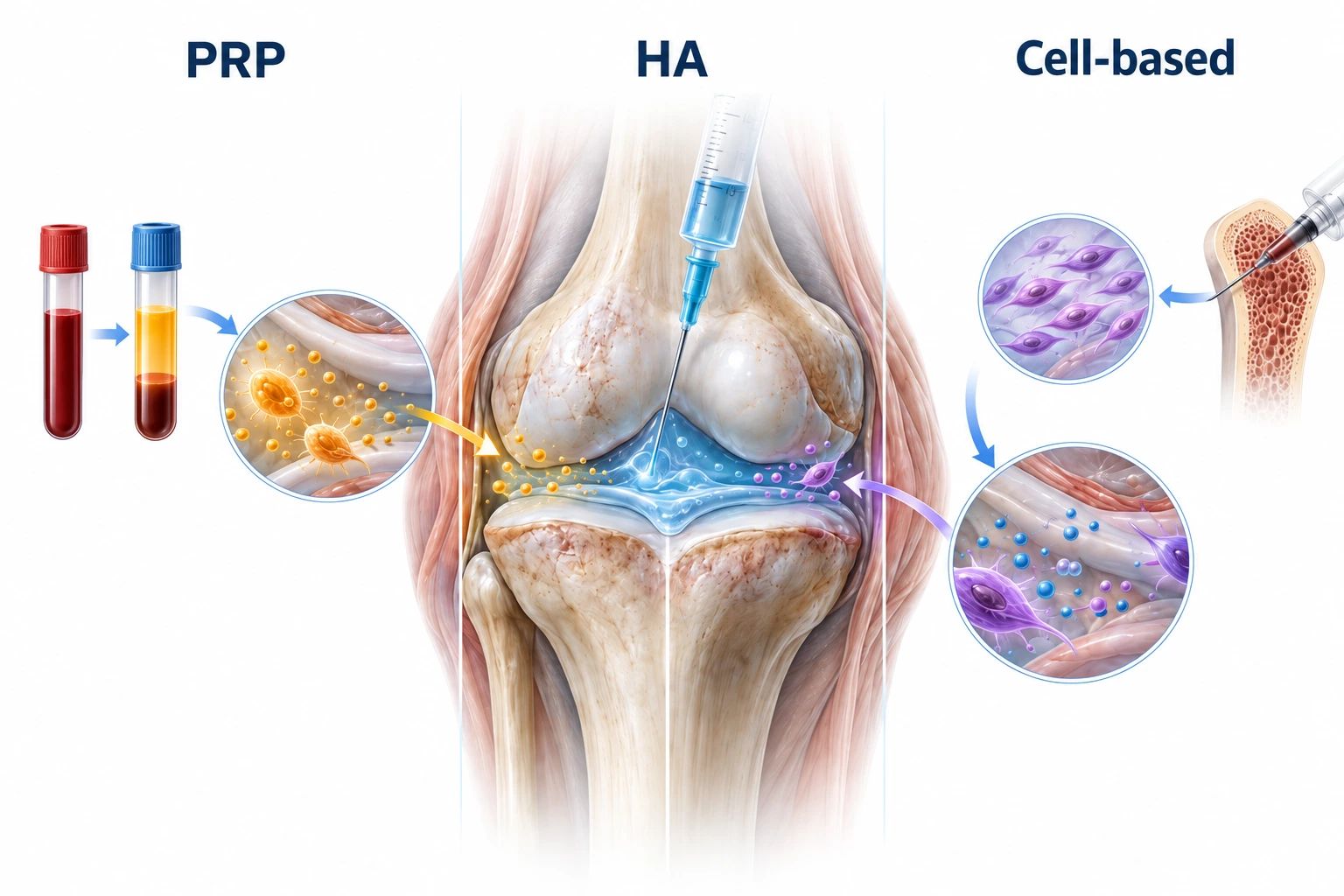
Stem Cells vs PRP or HA for Knee Osteoarthritis: What Sets Each Apart?
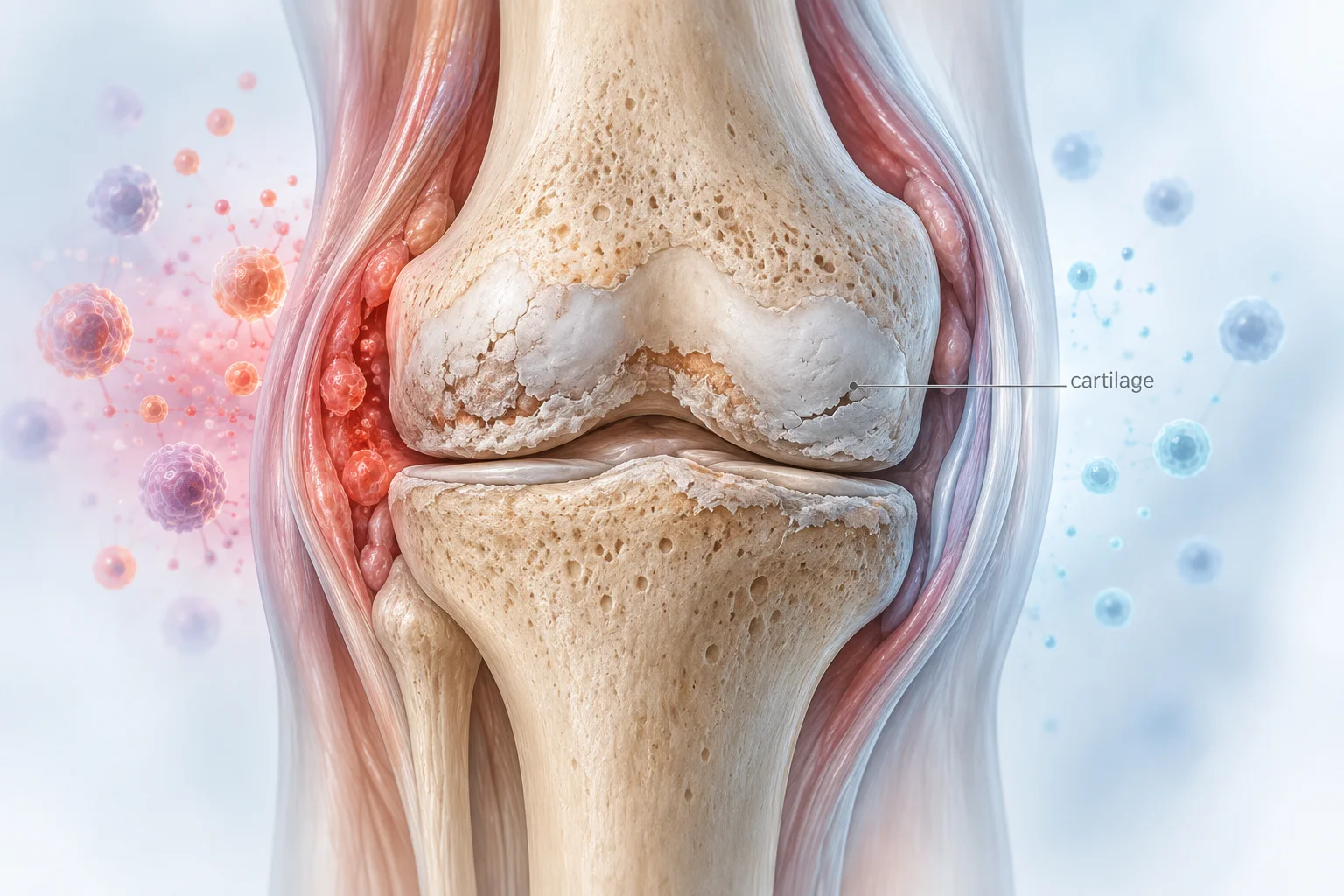
Specifically, knee osteoarthritis develops when cartilage inside the joint wears down over time. This leads to pain, stiffness, and swelling that often worsens with activity.
Platelet rich plasma PRP concentrates a patient’s own platelets from a routine blood draw. These platelets release growth factors that calm inflammation inside the joint.
By contrast, hyaluronic acid HA works differently. It supplements the joint’s natural lubricating fluid, aiming to reduce friction and directly cushion movement.
Meanwhile, stem cell therapy for knee osteoarthritis takes an entirely different approach. Mesenchymal stem cells release signals that may calm inflammation and support the joint’s own repair environment over time.
Researchers still debate how much of the benefit comes from actual tissue repair versus simple control of inflammation. Both mechanisms likely play some role, though their relative contribution remains an open question.
Why These Three Get Compared So Often
All three count as treatment options for patients who want to delay surgery. None of them physically replace a joint the way a prosthesis does, and none guarantee permanent relief.
Each option also varies widely in cost, how well known it is, and how long clinics have used it. Among the three, HA carries the longest track record. Stem cell injections, by contrast, remain far newer to the field.
Patients often ask which option makes the most sense first. Ultimately, the honest answer depends heavily on disease stage, budget, and what a patient has already tried.
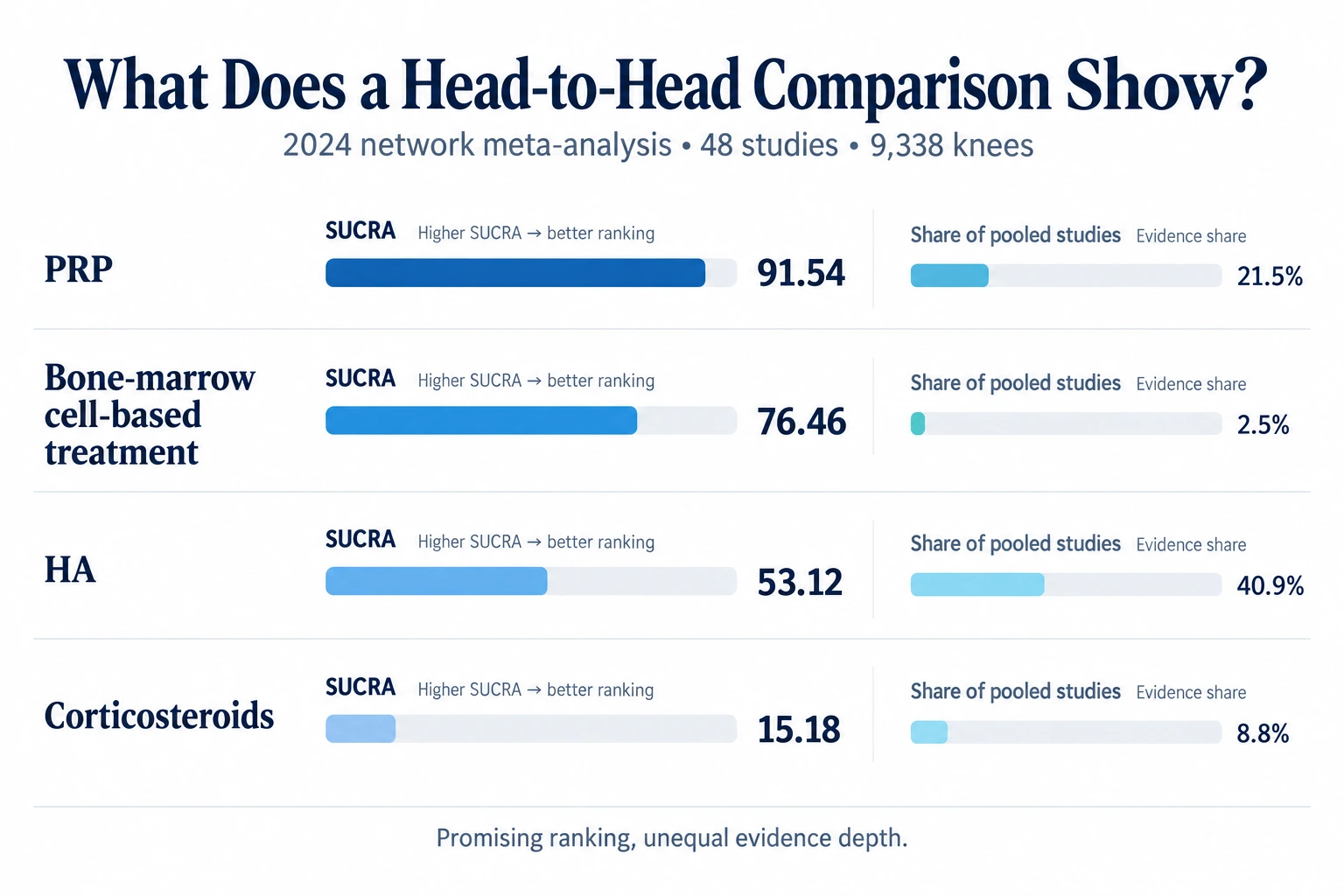
What Does a Head-to-Head Comparison Show?
A 2024 meta analysis published in Arthroscopy pooled data from 48 trials covering 9,338 knees. It directly compared four treatments: corticosteroids, HA, PRP, and bone marrow aspirate concentrate.
Bone marrow aspirate concentrate is a cell-based option related to stem cell therapy.
Researchers ranked each treatment using a statistical score called SUCRA. Higher scores indicate a greater likelihood of ranking highest for pain and function outcomes.
PRP scored highest overall, followed by the cell-based option, then HA. Steroid shots and placebo scored lowest by a wide margin, well behind every active treatment tested.
| Treatment | Share of Studies | SUCRA Score | Improved Pain vs Placebo |
|---|---|---|---|
| PRP | 21.5% | 91.54 | Yes, significant |
| Bone marrow cell-based | 2.5% | 76.46 | Not significant |
| HA injections | 40.9% | 53.12 | Yes, significant |
| Corticosteroids | 8.8% | 15.18 | Not significant |
Notice the share of studies column carefully. The cell-based option made up just 2.5 percent of the pooled evidence. By comparison, HA accounted for nearly 41 percent of it.
A smaller evidence base means more uncertainty around that specific SUCRA score. The ranking looks favorable, but it is based on far fewer studies than HA’s.
This gap matters for anyone reading these rankings at face value. A high score built on limited data deserves more caution than the same score built on dozens of trials.

What Do Major Guidelines Say So Far?
Most orthopedic guidelines still treat stem cell therapy as an emerging option rather than a standard recommendation. HA, in contrast, has appeared in clinical guidelines for far longer, though support has softened somewhat in recent years.
PRP, meanwhile, occupies a middle ground in most guideline documents. Several professional bodies now list it as a reasonable option worth discussing, though not yet as first-line care.
This cautious language reflects the same pattern seen in the trial data itself. Promising results exist, but the evidence base has not yet reached the size needed for confident, universal guidance.
How Do Stem Cells Compare With HA Specifically?
Meanwhile, a separate study focused specifically on mesenchymal stem cell types pooled 15 trials and 585 patients. Bone marrow derived stem cells showed a significant improvement in pain scales VAS scores compared with HA directly.
This finding lines up with the broader 2024 comparison above. Both point toward stem cell approaches performing at least as well as HA. Even so, neither study treats this as settled proof.
Adverse events told a more mixed story in that same research. Stem cell injections had more reported reactions than traditional therapy, even when pain outcomes were favorable overall.
Researchers were candid about this tradeoff. A treatment can outperform another in pain relief while still carrying a different, and sometimes higher, side-effect profile. This tradeoff matters just as much as the headline pain scores.
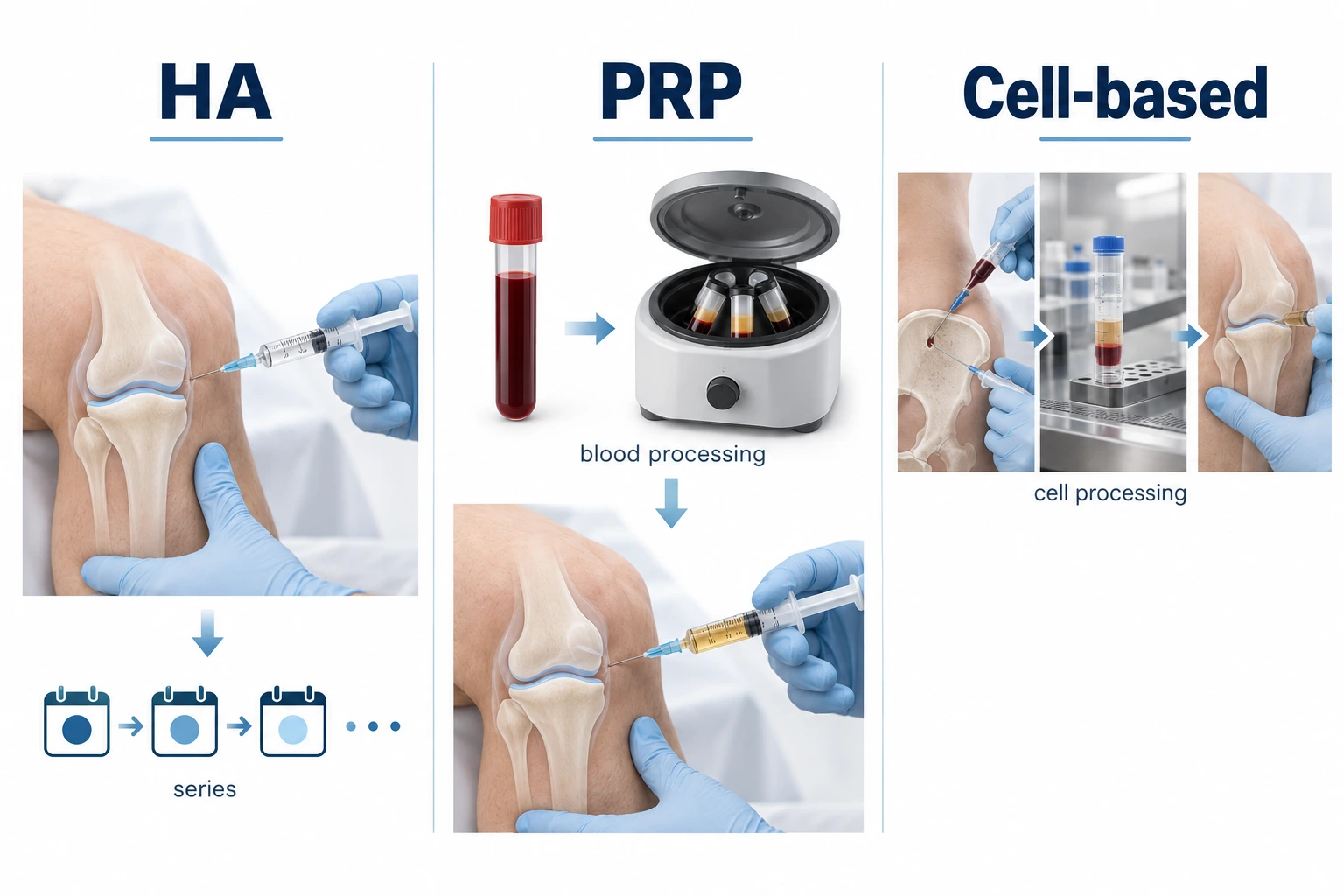
What About Cost and Practical Differences?
HA injections typically cost less than stem cell therapy, reflecting simpler processing and a much longer manufacturing history. PRP usually sits in between, since it still requires drawing and processing a patient’s own blood.
Insurance coverage also varies widely by country and provider. Many insurers still classify stem cell therapy for osteoarthritis as experimental, which significantly affects out-of-pocket costs. HA, by contrast, has broader coverage in many healthcare systems given its longer approval history.
Appointment frequency also differs between the three options. Many HA protocols involve a short series of weekly injections.
PRP and stem cell therapy, meanwhile, often involve a single session or just a few sessions spread over months. This difference alone influences which option fits a patient’s schedule and budget.
Cyrona Cell’s article on how mesenchymal stem cells support damaged joint tissue covers the underlying biology. It explains this mechanism in more depth for readers who want it.

What Do Safety Profiles Look Like Across Options?
HA injections carry the longest safety track record of the three, given decades of clinical use. Reported reactions are typically mild, such as temporary swelling or soreness at the injection site.
PRP has a similar safety profile because it uses a patient’s own blood. Overall, serious complications remain uncommon across the trials reviewed above.
Stem cell therapy showed a somewhat different pattern in the comparison discussed earlier. Reported reactions were more frequent than with traditional therapy, though still generally mild and short-lived.
None of the three options carries meaningful long-term safety data beyond a few years. This gap applies across the field, not to any single treatment or clinic specifically.
Lifestyle factors also shape outcomes regardless of which injection a patient chooses. Weight management and appropriate exercise remain part of standard care, regardless of which of these three options is chosen. No one should treat either as a separate afterthought.

Who Tends to Benefit Most From Each Option?
Patients with milder, earlier-stage osteoarthritis often try HA or PRP first. This makes sense given the larger evidence base and lower cost of both options.
A few practical signs tend to point toward stem cell therapy specifically:
- HA or PRP gave only short-lived or no relief
- Physical therapy alone has not resolved ongoing pain
- Surgery feels premature given imaging and symptom severity
- A patient wants to explore every reasonable option before joint replacement
Stem cell therapy more often enters the conversation once those options no longer provide lasting relief. Cyrona Cell’s guide on stem cell therapy for joint pain after PRP and physio walks through this exact sequencing.
For a broader look at stem cell therapy alone, see Cyrona Cell’s overview on stem cell therapy for osteoarthritis. That piece covers the effect on delaying joint replacement.
A physician typically reviews imaging, prior treatments tried, and overall joint condition before recommending any specific option. No single treatment fits every patient equally well.
Weight, activity level, and disease severity all factor into that decision too. Ultimately, the choice between stem cells vs PRP or HA comes down to a patient’s specific case.
No amount of ranking data replaces a proper physical exam and imaging review. Rankings describe averages across large groups, not guarantees for any one individual.
Frequently Asked Questions About Stem Cells vs PRP or HA
Is stem cell better than PRP for knee arthritis?
Current evidence does not clearly favor one over the other. A 2024 comparison of treatments ranked PRP slightly higher than cell-based therapy.
However, the cell-based data pool remains much smaller. For this reason, neither option has clearly proven superior.
Is hyaluronic acid a better treatment for knee osteoarthritis than PRP?
Most comparative evidence favors PRP over HA for pain and function scores. However, HA still showed significant improvement over placebo. It also carries the group’s largest and most established evidence base by a wide margin.
What is the most effective treatment for osteoarthritis in the knees?
No single injection works best for every patient. PRP scored highest in the largest recent comparison. Individual response still varies by disease stage, cost tolerance, and prior treatments tried.
Will stem cells regrow knee cartilage?
Current evidence does not support full cartilage regrowth from stem cell therapy. Instead, most benefits center on pain relief and functional improvement, not on rebuilding cartilage structure. Patients should treat this as a realistic expectation from the start.
Ask About Stem Cell Therapy for Knee Osteoarthritis
Curious whether your case fits current evidence for stem cell therapy, PRP, or HA?
Start your application and Cyrona Cell’s team will review your imaging and history to discuss realistic options.