
Key Takeaways
- Patients with a donor cord blood cell implant reported lower pain scores at five years than patients after microfracture (23.4 versus 46.3 on VAS).
- Durable repair tissue on MRI appeared in 62.5% of the cell group versus 26.3% of the comparison group, yet average MOCART scores did not differ.
- The analysis was retrospective (level III evidence), and only 48 of 89 original trial participants reached five-year follow-up.
- A 2025 Cochrane review of 25 trials found only small, low-certainty gains from stem cell injections in knee osteoarthritis.
Estimated read: 8 min
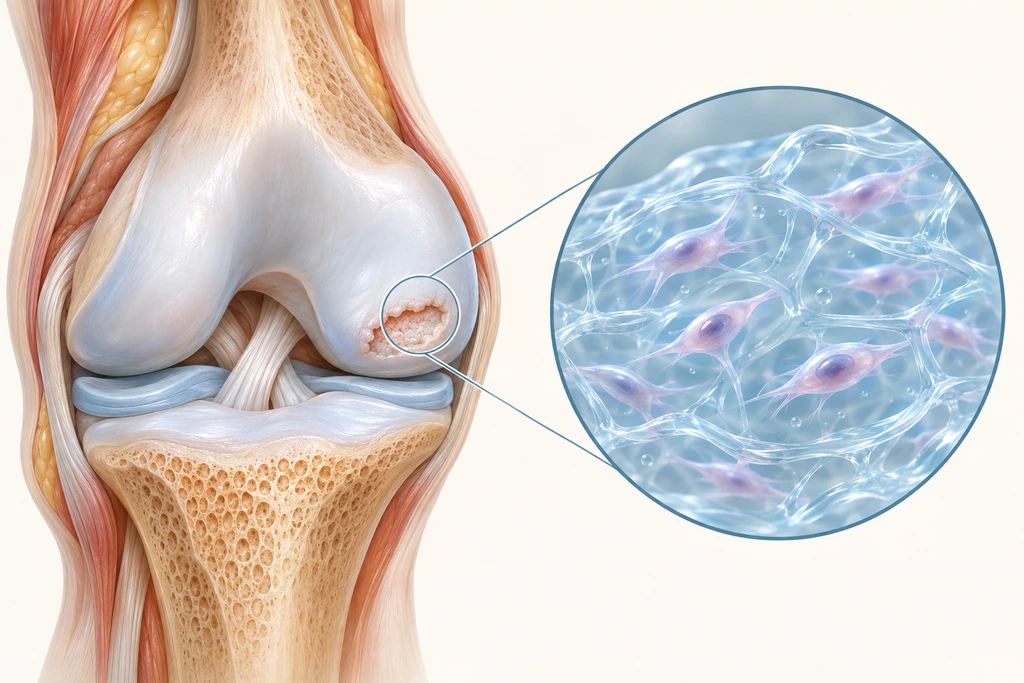
Knee Osteoarthritis Stem Cell Study: 5-Year Results in Brief
Patients with the cell implant reported less pain and better function at five years than patients in the comparison group. The cell group also had more MRI-defined durable repair tissue. Yong-Beom Park and Chul-Won Ha reported the findings in Arthroscopy’s five-year cartilage study.
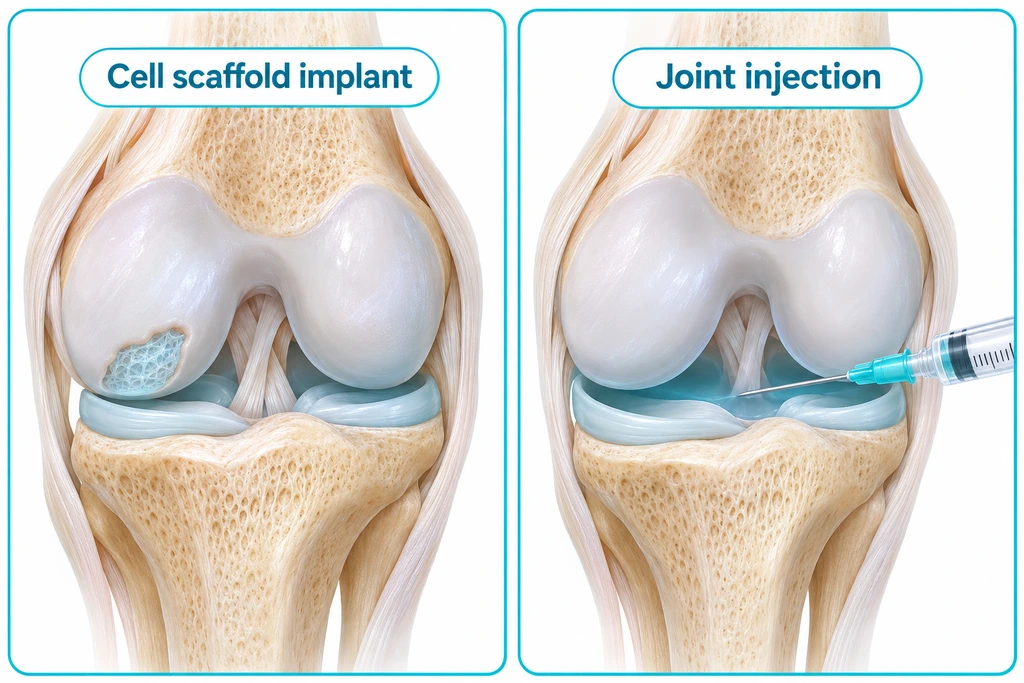
The implant combined allogeneic umbilical cord blood-derived mesenchymal stem cells with a gel-like scaffold. Allogeneic means the cells came from a donor instead of the patient. Researchers study these mesenchymal stem cells (MSCs), also called mesenchymal stromal cells, for their ability to calm inflammation and support repair.
The journal published the paper online on October 31, 2026. Because the team looked back at existing data, readers should interpret it carefully. Our guide to mesenchymal stem cells in osteoarthritis explains how mesenchymal stem cell therapy may work.
How Researchers Designed the Study
The researchers reviewed part of an earlier phase 3 trial. That makes it level III evidence, a weaker design than a new randomized trial. Therefore, the results show an association, not proof of cause.
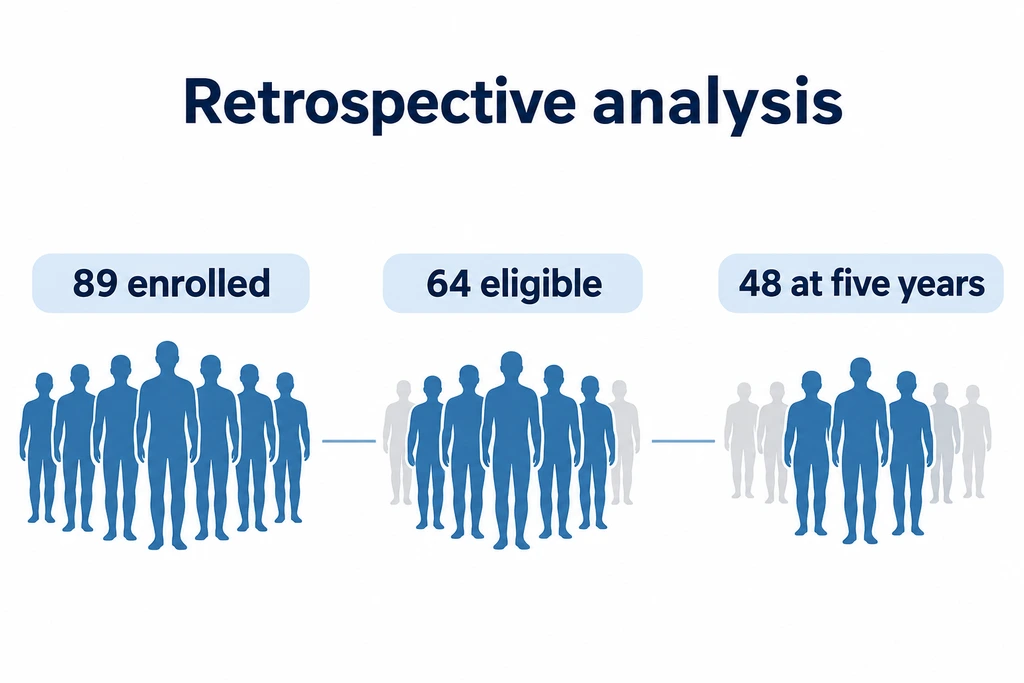
The original trial enrolled 89 patients. Of those, 64 qualified for inclusion, and 48 completed five years of follow-up. All had Kellgren-Lawrence grade I to III osteoarthritis, which covers mild to moderate X-ray changes.
Researchers compared the cell implant with microfracture, a surgery that drills tiny holes in bone to trigger repair. They scored pain on the visual analog scale (VAS).
The Western Ontario and McMaster Universities Osteoarthritis Index (WOMAC) measured pain, stiffness, and function. IKDC scores rated knee function, and MRI-based MOCART scores graded cartilage at three and five years.

What Patients Reported After Five Years
Patients with the cell implant reported less pain and better function than comparison patients. All three score gaps were statistically significant.
At five years, VAS pain averaged 23.4 in the cell group and 46.3 in the comparison group (P = .0019). On the WOMAC, the cell group averaged 21.8 and the comparison group 37.7 (P = .016). For the IKDC, the averages were 59.4 and 46.5 (P = .014).
Lower VAS and WOMAC scores mean less pain and disability. Higher IKDC scores indicate better knee function.
Rates of reaching a minimal clinically important difference also leaned toward the cell group. For example, 50.0% versus 28.1% reached it on VAS, and 53.1% versus 28.1% on WOMAC. However, none of those gaps reached significance, so the benefit for individual patients remains uncertain.

Does the MRI Show More Durable Cartilage Repair?
Partly. More patients in the cell group had durable repair tissue, but average MOCART scores did not differ between the groups.
The researchers defined durable cartilage repair as a MOCART score above 60 at both three and five years. Repair also had to remain stable, with less than 10 points of change between assessments. By that rule, 62.5% of the cell group had durable repair, versus 26.3% after microfracture (P = .031).
The cell implant was the only factor linked to durable repair (odds ratio 8.2, 95% CI 1.6 to 42.5). That range is wide, so the true effect size is uncertain.
Lower limb alignment showed no link to clinical or MRI outcomes. That matters because misalignment can lead surgeons to consider high tibial osteotomy, a procedure that realigns the knee.
How Earlier Trials Compare
Earlier trials used different cells and shorter follow-up, so comparisons need caution. Each reported symptom gains, but none proved lasting joint repair.
In 2015, Vega and colleagues published a randomized trial in Transplantation. Its title read “Treatment of Knee Osteoarthritis With Allogeneic Bone Marrow Mesenchymal Stem Cells: A Randomized Controlled Trial.” They randomized 30 patients into two groups of 15.
One group received bone marrow-derived cells, and the control group received hyaluronic acid. After 12 months, the cell group showed greater improvement in pain and disability.
MRI T2 mapping also suggested better cartilage quality in treated patients. Still, the trial was small and used an active control instead of placebo.
Kim and colleagues reported a 2022 five-year follow-up in Stem Cells Translational Medicine. They tracked 11 patients after a single intra-articular injection of autologous adipose-derived mesenchymal stem cells. Pain and WOMAC scores stayed improved, but MRI gains faded toward baseline by years four and five.
That study had no control group. Also, nine of 11 patients used joint injections or anti-inflammatory drugs as needed. Two authors reported grants from the funding company.

What the Cochrane Review Adds
A large Cochrane review found only small, low-certainty benefits from stem cell injections in knee osteoarthritis. It also found no clear proof of structural repair.
Cochrane’s stem cell injection review, published in 2025 by Whittle and colleagues, pooled 25 trials with 1,341 participants. These randomized controlled clinical trials suggested that stem cell injections may slightly improve pain and function compared with placebo. The authors rated that evidence as low certainty, partly because cell source, preparation, and dose varied widely.
These findings frame the knee osteoarthritis stem cell study: 5-year results. One positive comparison is not enough to confirm clinical efficacy and safety over the long term. Readers weighing options can also compare stem cells versus hyaluronic acid for knee osteoarthritis.

Limits Patients Should Weigh
The knee osteoarthritis stem cell study: 5-year results carry clear limits. Its design is retrospective, and only 48 of 89 original participants completed five-year follow-up. Attrition of that size could skew the findings.
This article draws only on the PubMed abstract. That abstract lists no adverse events, funding, or conflict-of-interest details, so safety and bias remain open questions.
Results for knee osteoarthritis (OA) with one cord blood product may not apply to other cell therapies. Patients whose symptoms persist after conservative care may find joint pain after PRP useful background. The study did not show a cure, and any cell-based option warrants discussion with a specialist.

Why Five-Year Follow-Up Matters
Five-year data matter because many cell therapy trials stop within a year. Short follow-up can miss whether early gains fade.
The 2015 Vega trial followed patients for 12 months. Cochrane’s summary reports only slight gains against placebo for up to six months. By contrast, the Kim follow-up showed pain scores holding for five years while MRI gains faded.
Against that background, a five-year edge over the comparison treatment is notable. Still, a retrospective comparison cannot show that the gap will last beyond five years.

Questions to Ask Before Considering Cell Therapy
Patients should ask which cells the team used, how it prepared them, and whether the evidence comes from randomized trials. Cochrane reviewers downgraded the evidence partly because cell source, preparation, and dose differed across studies.
Patients can also ask what comparison group the trials used and how long the follow-up lasted. Questions about reported adverse events, funding, and conflicts of interest help too, since this abstract lists none.
A good specialist should answer these questions plainly and describe the uncertainty honestly. Registered clinical trials often publish protocols and outcomes in advance, making them easier to check.
Frequently Asked Questions
Does stem cell therapy cure knee osteoarthritis?
The study found no sign of a cure. Pain scores were lower in the cell group, and more patients had durable repair tissue. However, average MOCART scores were similar in both groups.
How long did the benefits last in this study?
Researchers measured outcomes at five years, and scores favored the cell group then. However, the team assessed only 48 patients, so that individual results can differ.
Were the cells taken from the patient?
No. The implant used allogeneic donor cord blood cells. By contrast, some other studies used the patient’s own cells, such as autologous adipose-derived cells.
Should cell implants replace microfracture?
The evidence is not strong enough yet. Still, the cell implant scored better at five years, but the design was retrospective and only 48 patients finished follow-up. A surgeon should match any option to lesion size, age, and goals.

Where the Evidence Stands Now
The knee osteoarthritis stem cell study: 5-year results are promising but not definitive. Cord blood cell implants improved pain and function scores, and more patients retained durable repair tissue. Even so, the retrospective design and heavy attrition limit confidence.
Larger randomized trials with full safety reporting will show whether the benefit holds. Until then, patients should treat these findings as encouraging evidence, not a guarantee.