Key Takeaways
- Moorfields and UCL researchers treated nine adults with a rare eye disease in a first-in-human clinical trial.
- Average eye surface scores improved from 9.4 to 5.9 at three months and held at 6.7 after 12 months.
- Vision rose by about five chart lines on average, but the 95% confidence range included no change.
- One early serious adverse event led the team to change the graft’s manufacturing process.
- A larger controlled trial is the next step, so the scaffold is not yet an approved treatment.
Estimated read: 5 min
The headline “Stem Cell Eye Treatment Improves Vision in Small Human Study” is accurate, but it needs context. Moorfields Eye Hospital and UCL tested a stem cell scaffold in nine adults with a rare genetic eye disease. The results are early and encouraging, but they do not yet prove restored sight.
Stem Cell Eye Treatment Improves Vision in Small Human Study: What Is Proven?
Partly, because the trial showed clear improvement in eye surface health, but the vision gain stayed uncertain. So the claim “stem cell eye treatment improves vision in small human study” is fair only with caveats. Larger controlled trials must settle the rest.
Dr Abigail Kaye and Professor Sajjad Ahmad led the study, published in July 2026. Their peer-reviewed JAMA study of the RAFT-OS eye trial calls the approach workable and asks for longer, controlled studies. Another early result appears in our report on what a recent heart failure stem cell trial found.
How the Eye Surface Trial Worked
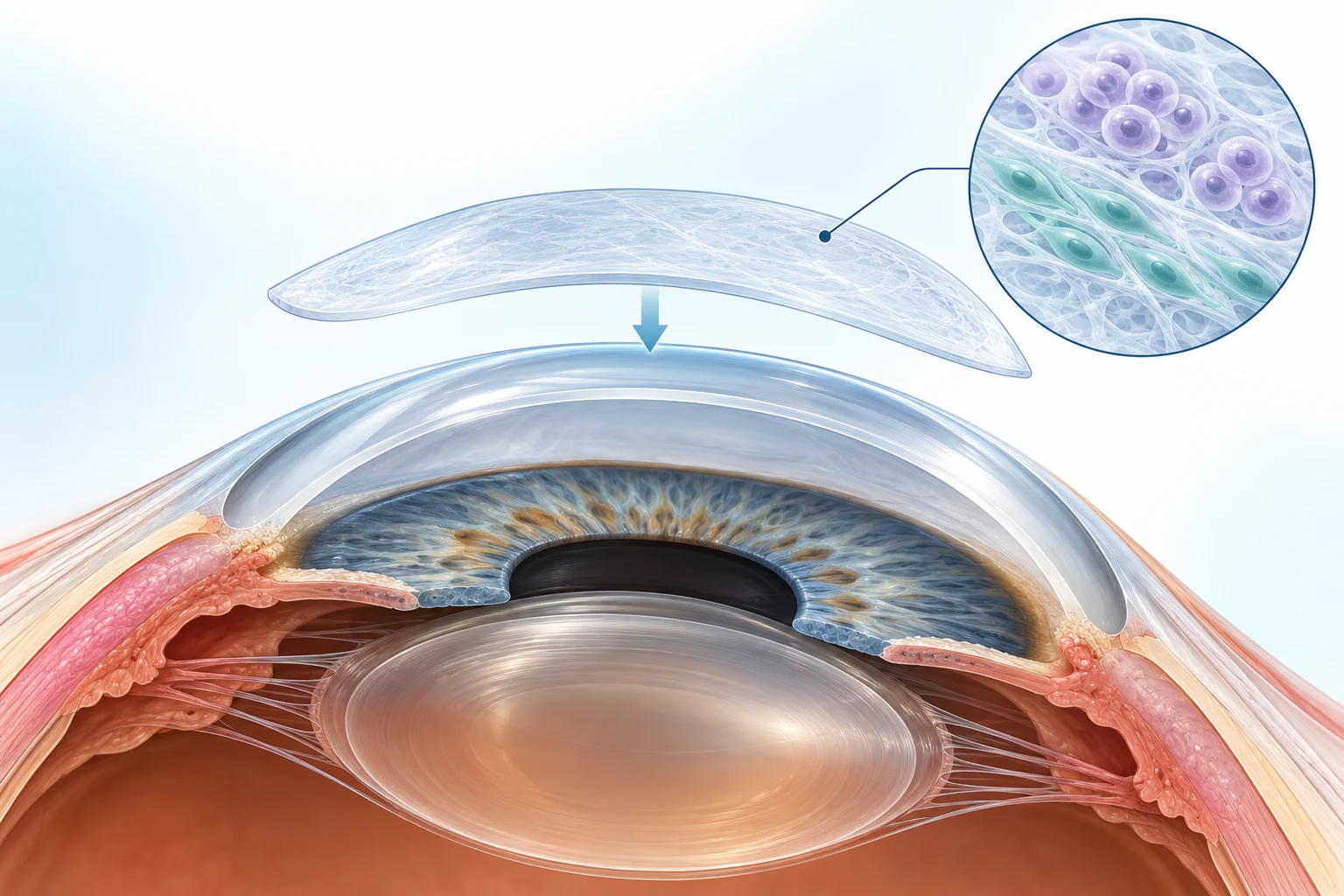
Surgeons placed a collagen scaffold loaded with two types of stem cells onto the damaged eye surface. The scaffold is called RAFT-OS. It carried donor limbal epithelial stem cells and a stromal cell type from the cornea’s middle layer.
This cell transplantation targets a disease that slowly clouds the cornea. The cause is a lack of limbal stem cells.
This rare genetic condition, present from birth, results from a PAX6 gene mutation. According to UCL, about 1 in 40,000 to 1 in 100,000 people have it. Nine adults joined this early clinical trial, and each received the graft in one eye.
What the Results Show About Vision Loss
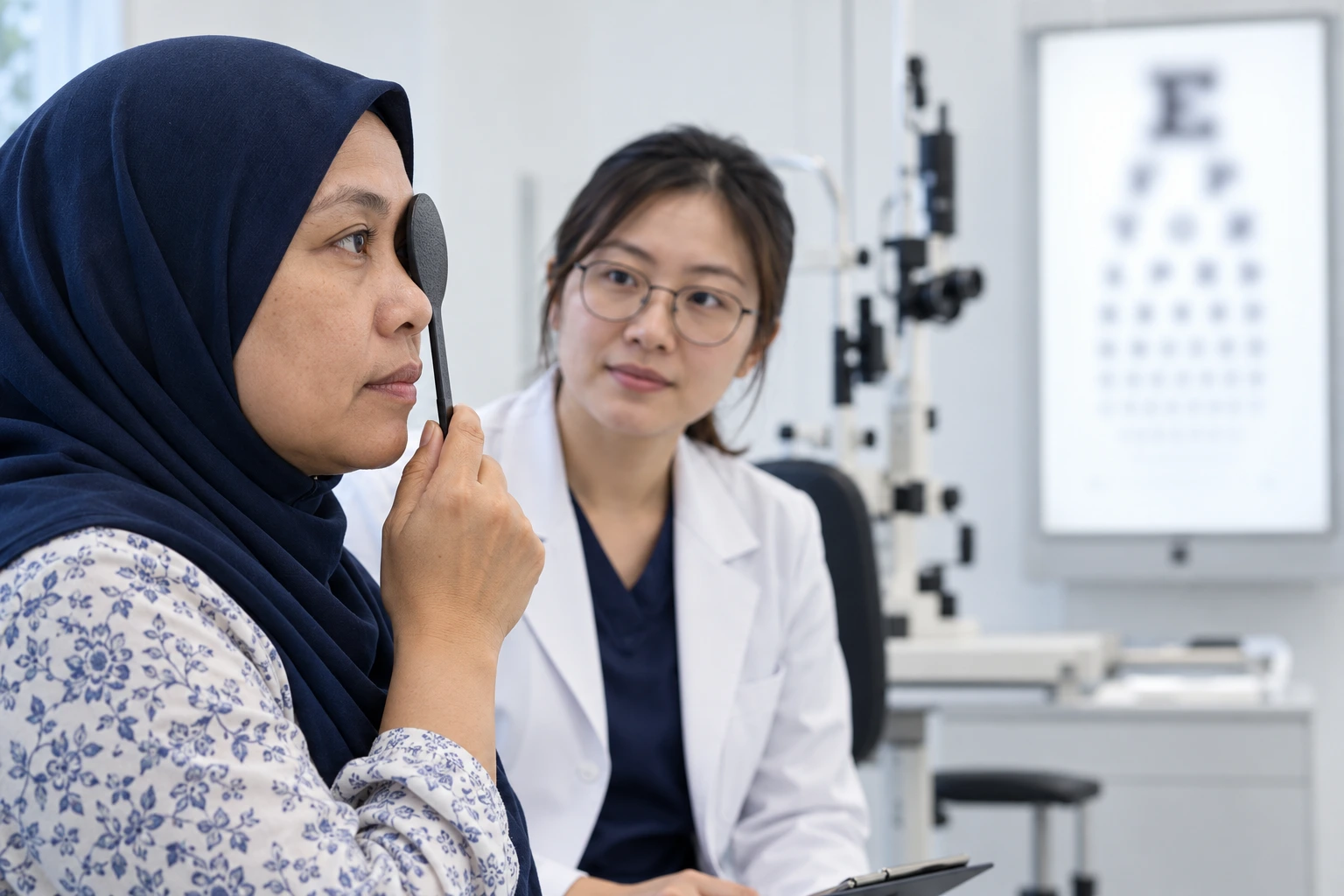
After the stem cells treatment, treated eyes improved on the ocular surface score, from 9.4 to 5.9 at three months. That gain eased to 6.7 at 12 months, while untreated comparison eyes barely changed. Lower scores mean healthier surfaces.
Vision improved by about five chart lines, or 24 letters, on average after 12 months. Yet the 95% confidence range included no change, so whether it can improve vision remains uncertain. Average sight in treated eyes also stayed near 20/1280, which is still severe vision loss.
Safety and Immune Risks
The authors reported no substantial safety concerns, yet the trial did record problems. One early serious adverse event led the team to change how it makes the graft. No further major RAFT-OS events followed, although two participants developed persistent epithelial defects.
The cells come from donors, so patients took medicines that calm the immune system, the trial registry says. Cell therapies differ widely in risk. Our explainer on why paused CAR-T trials show cell therapies are not all the same and explains how.
Longer follow-up must also catch rare or delayed problems.
What It Means for Other Eye Conditions
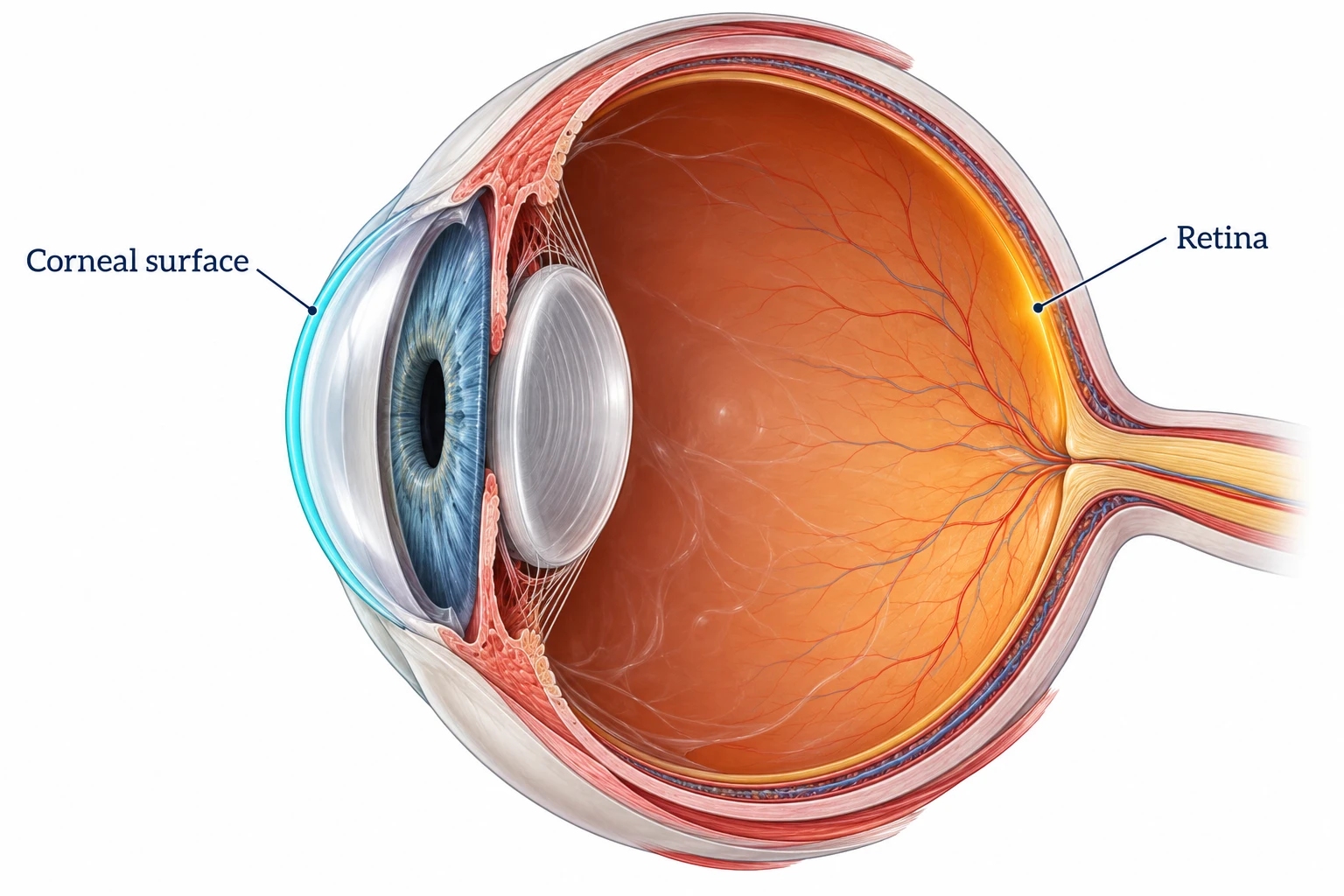
This trial did not test the retina or the optic nerves. It treated only the eye surface in people with this rare genetic disorder. Age related macular degeneration and diabetic retinopathy, however, damage different tissue.
A separate early trial implanted stem cell derived retinal pigment epithelial cells in advanced dry macular degeneration. Three-year follow-up of the retinal cell implants showed the implants stayed safe and well tolerated after about three years. Still, each condition needs its own evidence.
What Happens Next
Senior author Professor Sajjad Ahmad says the team wants a larger clinical trial and eventual NHS acceptance. He is a professor of corneal regeneration at UCL and a consultant eye surgeon at Moorfields. Optometry Today’s report on the Moorfields stem cell trial gave the plan but no start date or design.
Until a controlled study reports, “stem cell eye treatment improves vision in small human study” remains an early signal. The first trial had no randomized control group and followed only nine people for 12 months.
Larger studies will also need cell quality checks. We cover why in our report on Wharton’s jelly stem cell quality testing.
Frequently Asked Questions
Can stem cell therapy restore eyesight?
Current evidence does not show reliable results. Early studies show promise for some corneal and retinal problems, yet restoring vision remains unproven. Conditions such as retinitis pigmentosa and other forms of retinal degeneration still need larger controlled trials.
Can stem cell therapy help regenerate the optic nerve?
Evidence for this is still limited. A 2020 journal review says ways to replace lost optic nerve cells still need work. Nothing in the Moorfields results speaks to that question.
Will stem cells help macular degeneration?
They may help, although the evidence is still early. Researchers aim to replace the damaged retinal pigmental epithelium with lab-grown cells in dry disease. Follow-up data confirm safety but do not yet show improved vision.
What is the most recent breakthrough in vision restoration?
The Moorfields and UCL trial is one recent step, not a settled breakthrough. It supports “stem cell eye treatment improves vision in small human study” only as an early signal. Larger controlled trials must still confirm any lasting benefit.